Wednesday, June 28, 2006

Cauliflower Soup


This is a good time of year for cauliflower. Piles of their creamy woolly heads are on all the vegetable stalls at Borough, enticing you to buy. They are incredibly versatile - chopped raw in salads and as crudité for dips, steamed as a side veg with grills or roasts, or they can be dipped in batter for fritters, theBritish classic cauliflower cheese is always welcome, they make wonderful soups and curries and spicy things - they are a great starting point for dinner. You have a cauliflower you have possibilities.

I think cauliflower are a very elegant vegetable - their paleness offset by a wrapping of light green leaves, the dense heads supported by webs of thin ribbing. They need milk in the cooking water to keep them white and a bayleaf to add a hint of that mysterious bay flavour and to sweeten the aroma as it cooks. The nutty, slightly smoky flavour and the densely curled texture make it ideal with little else done to it though it really is at its best with either added dairy or added spices and aromatics, depending on your mood.

This soup goes for added dairy - butter particularly - to add a lush richness to the finished dish. The recipe comes from John Burton-Race French Leave - and is gloriously decadent.

Cauliflower Soup with truffle oil

1kg fresh cauliflower
150g unsalted butter
1 onion, peeled and chopped
1 garlic clove, peeled and chopped
1 sprig fresh thyme
1 bayleaf
800ml milk
800ml chicken stock
Salt and white pepper
75ml truffle oil

Trim, wash and break the cauliflower into pieces or small florets. In a large, lidded saucepan, melt the butter and add the cauliflower, stirring to coat each piece with melted butter. Cover the pot and cook over a low heat for 10 minutes. Add the onion, garlic, thyme and bayleaf, stir, then cover again and cook for five minutes longer.

In another pan, heat together the milk and chicken stock. As soon as they have come to the boil, pour them over the cauliflower. Turn up the heat and cook the soup on a rapid simmer for half an hour, or until the cauliflower is soft.

Check the seasoning, adding salt and pepper to taste, then pour the soup into a liquidiser and blend until smooth. Pour back into a saucepan and return to the boil. Turn off the heat and add the truffle oil. Whisk the soup (use a hand blender if you have one) until it froths. Ladle it into lightly warmed soup bowls and serve immediately.

With some crusty bread it's a great lunch, or brilliant as a starter for a dinner party. This recipe serves 8 - treat yourself to leftovers the next day or freeze the soup you won't use - it reheats very well indeed.

Friday, June 23, 2006

Grilled Aubergine Salad


Aubergines - or eggplants as they are called in Australia - are a strange vegetable. They are almost seductively beautiful in all their incarnations - most often sleek and glossy and black as a starless night but they also come in a whole palette of colours ranging from creamy tinged with pale green through mauve stripes to deep purple, always topped with a green cap that looks like it's been hand cut from felt. They have no perfume to give a clue to what they will be like to eat, they are surprisingly light when you lift one and hollow sounding when you tap it, seemingly not quite substantial enough, misleading somehow to the casual shopper.

The first few times I bought one it sat in the fridge till it went bad and I threw it away because I didn't have a plan for it. They are a challenge to use if you have no history with them - I was about 23 before I tried one. They weren't terribly mainstream in suburban Australia when I was growing up! Eventually I bought one with a recipe in mind and discovered the pleasure of baba ghanoush - and I was hooked. There is something about the silky flesh and the slight hint of smoke that works with so many other ingredients, particularly in Middle Eastern inspired dishes. They need a light hand with any oil - they can soak up what seems like a thousand times their own weight in about half a second, but otherwise they are always rewarding to cook with.

This recipe comes from Sam and Sam Clark - the brilliant couple who run Moro in Exmouth Market - on the bbc website. The secret ingredient, I'm convinced, is the smoked paprika. It really is magic in your mouth.

Grilled Aubergine Salad

1kg/2¼lb aubergines
5-6 tbsp olive oil
3 cloves garlic, cut into thin slivers
1 tsp coriander seeds, roughly ground
2 tsp cumin seeds
1 large tomato, skinned and chopped
1½ tsp smoked paprika
5 tbsp roughly chopped fresh flatleaf parsley
6 tbsp roughly chopped fresh coriander
1½ tbsp lemon juice
salt and freshly ground black pepper

Grill the aubergines whole over the naked flame of a gas hob, or under the grill, turning until the skin of the aubergines is charred and crispy all over and the flesh is soft. When cool enough to handle, cut off the tops and peel off the skin, scraping the flesh off the back of the skin if necessary. Roughly chop the aubergine and set aside.

Place a large frying pan or saucepan over a medium to high heat. Add the oil and when it is hot but not smoking, add the garlic. Fry for a few seconds until it begins to colour, then add the ground coriander and cumin seeds. Stir a little and cook for a further 10-20 seconds to bring out the flavour of the spices, then add the chopped aubergine, tomato, paprika, parsley, three tablespoons of the fresh coriander, and finally the lemon juice. Give everything a thorough stir so that all the ingredients are evenly mixed. Season with salt and freshly ground black pepper.

Turn the heat to low and continue to cook for 20-30 minutes, stirring every five minutes to scrape off any caramelised bits that have stuck to the bottom of the pan. The aubergine is ready when it is no longer watery. To finish, stir in the remaining coriander and taste for seasoning once more.

Serve it warm with an omelette and some pitta bread, and it is fabulous cold next day for an exotic treat for lunch.

Tuesday, June 20, 2006

Potato Salad


This country has great potatoes - it is not the home of 'anything that goes with chips' for no reason. In spring and early summer Borough Market sells the best of the new potatoes - jersey royals and cornish new mountains appear like magic to disappear again by the end of the day. Jersey royals have EU protection status, earned by the care with which this crop is, and always has been, grown.

These little nuggets of gold with their delicate papery skins are sown in January on the hillside farms, and fertilised with vraic, seaweed harvested from local beaches to create a delicate, nutty little kidney shaped potato that brings maybe 12 weeks of joy to the mainland.

They are best eaten simply - as with all perfect ingredients. Early on I buy them and rub off the loose skins then boil them for 10 minutes and serve them slicked in melted butter and a quick grinding of black pepper and maldon sea salt. But they also make a sublime potato salad. The best for me is keep it simple - choose the quantity you want to eat, rub the skins off, boil in salted water till tender, drain and cool, then - and this is an entirely intentional use of this usually pretentious term - enrobe in Hellmans (and yes it has to be Hellmans unless you make your own mayonnaise), perhaps with a grinding of pepper.

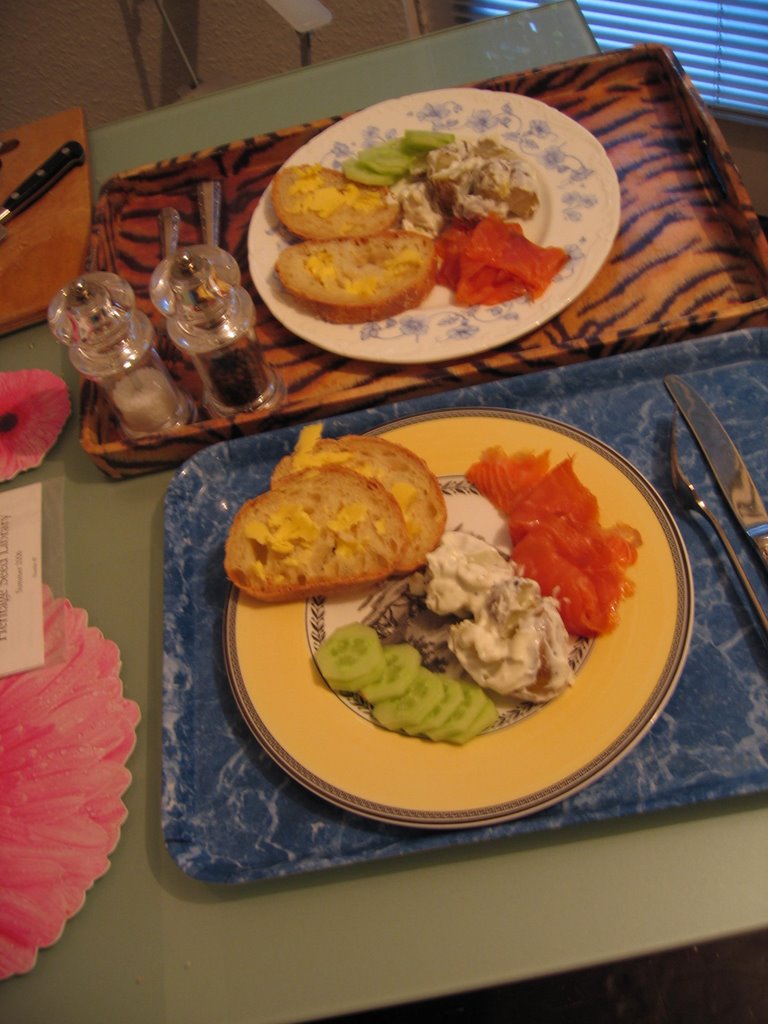
I made a big bowl of this salad Sunday night to accompany rare roast beef. Monday we had it in lunchboxes with slices of pork pie and raw sugarsnap peas. The last of it will go with the Irish smoked salmon I bought at Borough Saturday with a green salad and some crusty bread from Paul. It lasts happily for a few days in the fridge, cutting down on prep time for meals while adding a creamy lushness. And they're not even expensive!

Thursday, June 15, 2006

Celery Soup


Mostly when people talk about a really memorable dish it comes from the mists of the past, often wrapped in childhood pleasures. Or else the choice will be something eaten whilst travelling, something foreign and indescribably marvellous. There's a lot to be said for those kind of favourites but often their defining characteristic is that they are now unrepeatable due to lacking the 'secret' knowlegde of the exact construction. And then sometimes you try a new dish now, in the present, and it so far surpasses expectations that it is a revelation, the very definition of delight. Such is this celery soup.

Celery is a hugely versatile vegetable in salads and casseroles, adding unique flavour and texture. Usually there in a support role adding depth and complexity, celery is seldom the star of the show - which is a shame. Right now there are bright green mounds piled high on the vegetable stalls of Borough Market, stiff ribs pointing north/south, traces of rich fenland soil clinging to the base. It's a perfect time to make this soup, its subtle delicacy just right at the end of a warm day, the rice making it substantial enough to be a main course with a little bread and cheese to follow. It comes from The Classic Food of Northern Italy, the marvellous book by Anna del Conte.

It is easiest to make the base one day and finish it the next. Then it will seem effortless.

Rice and Celery Soup

450g/1lb celery, preferably green as it has a stronger flavour than white
125g/4oz floury potato
2.2l/4pt stock - vegetable or chicken
4 tbspn olive oil
30g/1oz butter - unsalted if you have it
2 tbspn finely chopped onion
125g/4oz Italian rice, preferably Vialone Nano
freshly grated Parmesan

Remove the inside leaves from the celery. Wash, dry and chop them. Set them aside for the final touch. Remove the strings from the outer celery stalks with a potato peeler. Wash the stalks and cut half of them into pieces. Peel the potato and cut into similar pieces. Put both chopped vegetables into a heavy pot with half the stock and half the oil. Bring to the boil and simmer gently until the vegetables are cooked. Whizz till smooth with a blender or food processor. This much can be done a day in advance.

Put the remaining oil, butter and onion into a clean pan and sauté for about 10 minutes. Cut the remaining celery into thin sticks, about 2.5cm/1in long and throw into the pan. Stir it around to insaporire (pick up the flavour) for 5 minutes. Add the celery and potato purée to the pot. Mix well and then pour in the remaining stock gradually, while stirring with the other hand to incorporate the purée into the stock. Bring to the boil.

Add the rice, give a good stir and let it cook until tender, about 15 minutes. Be careful here - it may need more stirring to prevent it sticking/burning.

Ladle the soup into bowls, sprinkle with the reserved celery leaves and serve with grated Parmesan. Anna del Conte suggests 'Some people will love to add it' - I'm one of them.

Monday, June 12, 2006

Pot Roast Hand of Pork


All a bit of a disaster really - such a hot weekend I think the heat must have melted my brain. The only vagueish plan I had when we set out for the market - apart from lots of stuff for salads -was to buy a small piece of boned leg of pork that wouldn't take too long to roast and have it with salads Sunday night while watching Hugh Fearnley Whittingstall's dvd of 'A Pig in a Day' - A masterclass in pig-rearing, butchery and piggy delights'. To enter into the spirit of the programme, you understand. But it was hot and Borough Market was already really busy though we were there by 9.30 and so I didn't stick to even the little bit of plan I had already made.

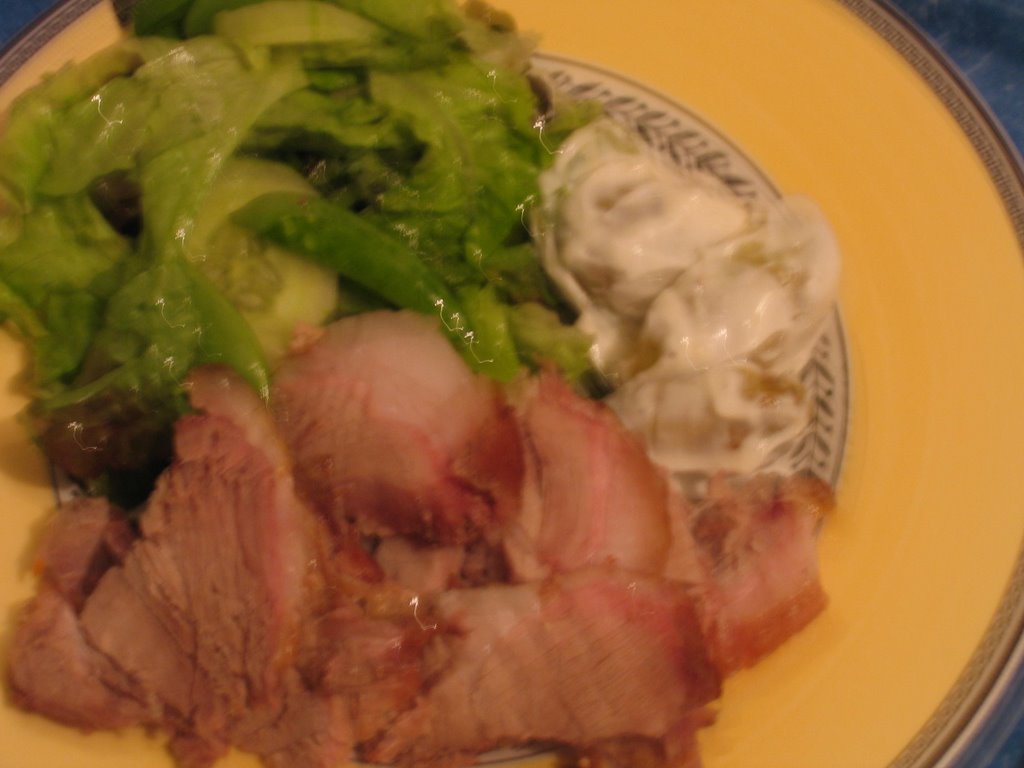
Went to Ginger Pig and they hands of pork, boned and rolled into 2 kg roasts for £10. Half of one would make a fine dinner. I recalled that I had a recipe from a while ago that I was interested in trying so I instantly changed my mind and bought one. Of course with the recipe coming from a while ago it was actually in a magazine in the winter when to slow roast a piece of meat over a couple of hours makes perfect sense. Certainly more so than doing it on the hottest weekend of the year so far. But then because I had it I cooked it anyway, but using a different recipe, but it still needed to be in the oven for 2 hours to soak up flavour and become tender. It was a good dish in the end but another time I would wait for a cool day. It created lots of juice which next time will be good as a light gravy over steamed vegetables. But for this meal the creamy potato salad and the glistening green one certainly made sense.

Of course by the time it was all ready it was too hot to watch the dvd - and I had become a right miss cranky pants - so the whole plan will be executed another day.

Pot Roast Pork

1/2 Boned, Rolled Hand of Pork
1 onion, finely diced
1 clove garlic, crushed
1 carrot, finely diced
1 celery stalk, finely diced
1 sprig rosemary, very finely chopped
5 sage leaves, very finely chopped
2 juniper berries, crushed
150 ml dry white wine
3 tablespoons grappa (if you have some)
200 ml chicken or hock stock
2 tbspns olive oil

Season the meat all over with salt and pepper, heat the oil in a heavy pan or casserole that is big enough to hold the meat and that has a tight fitting lid. Seal the meat over a high heat until browned all over then remove to a plate. Reduce the heat and add the chopped vegetables and herbs. Cook until the onion is translucent and the mix is fragrant. Return the meat to the pan and add the wine, grappa and juniper. Bring to the boil and then add the stock. When the liquid starts to simmer, cover with the lid and put into a hot oven - gas 6/200C/400F for a couple of hours, turning once halfway through. If it's a coolish day serve sliced with potatoes and steamed courgettes with a slick of gravy from the pan.

This would work equally well with a whole unboned hand but would then be difficult to carve - but obviously not impossible.

Thursday, June 08, 2006

Brown Rice Salad


Hooray - the sun is shining! And it's actually hot. Flaming June at last.

I had planned on a salady kind of week when we went to Borough Market on Saturday but Sunday turned into a lazy day - possibly related to the excess of wine I consumed on Saturday night - and things gots a bit out of kilter. I watched The Great British Menu occasionally when it was on BBC2 - a shamefully dull programme, particularly given the amount of talent they had in the kitchen - and was really taken by the food that Atul Kochhar made.

Using many of the same ingredients as the other chefs as his starting point he created a whole other world of food. Being Indian allowed him to see the 'challenge' completely differently as well as being the one chef who most accurately reflected what might be being eaten across the country (though obviously at a statospherically higher level when prepared by him). Seriously, when was the last time you made pan-fried turbot with cockles and oxtail for a midweek supper? But rice, lentils, chicken, curry sauce? Definitely in the repertoire. I didn't get as far as making the tandoori but we did have a wonderfully aromatic pilau rice and with simply roasted chicken with chilli and ginger. The leftover rice was fabulous cold for lunch next day - easily as good as it was hot. All the recipes from the series are in the lifestyles/food section of the bbc website.

Unplanned I also bought two buffalo mozzarella. I buy milk and often bread and yoghurt from Neal's Yard every week and every now and again they have overstocked on something and sell it at a bargain price. This week they were offering bogoff (buy one get one for free) on mozzarella and, having feasted before on this creamy delight I just could not resist. We went to a 6 o'clock screening of the risible Latin American film 'Secuestero Express' on Tuesday so we went home to a quick dinner about 9 o'clock of fennel salami, rocket picked fresh from the garden, crusty bread from Paul and - the highlight even in the midst of such brilliance - a ball of buffalo mozzarella. It was so good, we had the same on Wednesday night after I came home from my french class - c'est parfait and not much washing up.

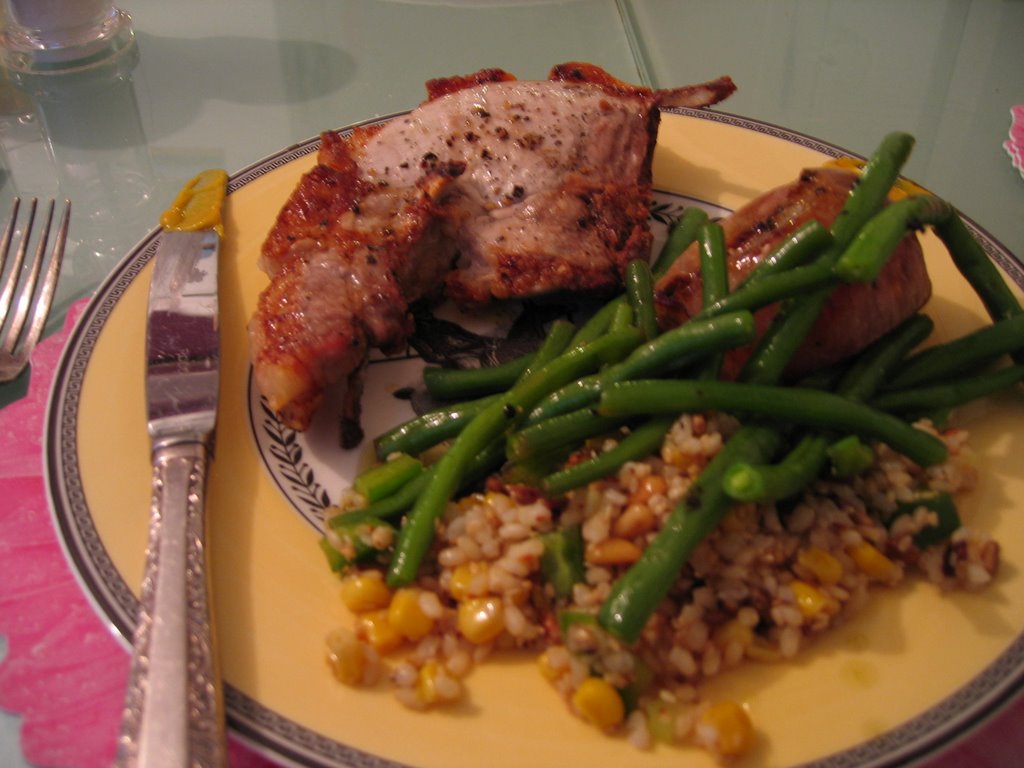
Today it's grilled pork chops for dinner. They need a couple of side dishes to make a proper meal and given that it is properly hot it has to be salad. The first is one that Georgio Locatelli wrote about in his column in the Guardian last week - simply slow roasting red onions till they're caremalised then mixing them with blanched green beans and oil and balsamic - a pretty sounding dish. Brown rice salad adds substance as well as pleasure. This a great salad, the toasted seeds adding luscious depth and the raw vegetables a kind of jewelled brightness. It's quick, it's cheap, it's probably good for you but best of all it is always a treat.

Brown Rice Salad

250g/1/2lb short grain brown rice
1 tbspn sesame seeds
1 tbspn pumpkin seeds
1 green capsicum, diced
2 stalks celery, diced
1 small can sweet corn niblets

For the dressing
3 tbspns olive oil
1 tbspn roasted pumpkin seed oil (or another of olive oil)
1 tbspn lemon juice
Salt and fresh ground pepper

Cook the rice in salted water for 20-25 minutes till tender but still slightly chewy. Drain and wash with cold water and allow to cool. Separately toast the seeds in a dry pan until golden. Add to the rice along with the vegetables. Mix the ingredients for the dressing, pour over the salad and toss well.

Do try and find roasted pumkin seed oil - bigger supermarkets sell it as well germanic delicatessans - as it really adds another element of flavour to this dish. Not sure what else it could be used for - but I find this is so good it's worth having in the cupboard for this salad alone.

Monday, June 05, 2006

Chickpea & Fennel Salad


Chickpeas are a wonderful ingredient. Like cannellini beans, chickpeas are an endlessly useful cupboard standby. Tinned, they pretty much last forever - not necessarily something I recommend putting to the test. Once opened and thoroughly rinsed they retain their texture and flavour very well indeed. They hold their own well when used in salads as well as blended to a rich creamy consistency in soups and classic dips like hummous. They have a delicate nutty flavour that mixes well with garlic and oils as well as aromatics like chilli and ginger and spices like cummin and coriander - they are a lovely versatile pulse. Like many pulses they are good for you as well as good to eat being very high in protein, fibre and slow release carbohydrates, and a valuable source of minerals like phosphorous and folate. But mostly I eat them because they taste great.

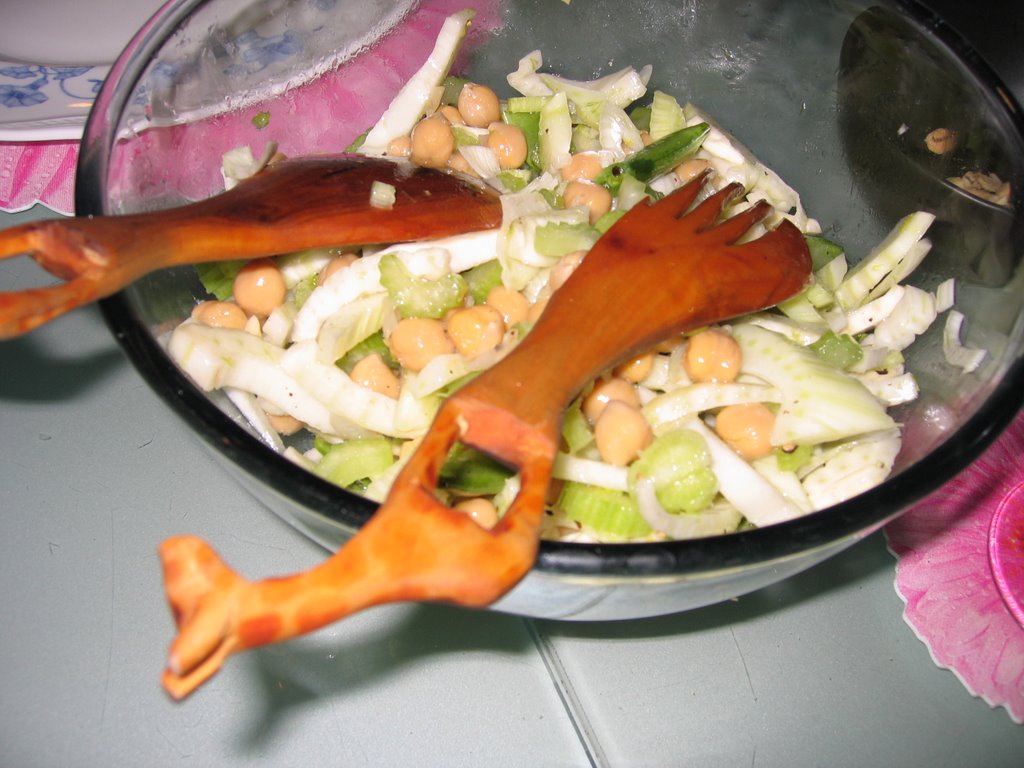
This salad is simple to make and is best left for an hour or two after dressing to let the flavours mingle a bit. The texture of the celery and the fennel are quite similar but they are clearly distinguished by their flavours - aniseed for the fennel and the celery adds an earthiness. The sugar snaps add another shade from the palette of green as well as a crisp sweetness.


Chickpea & Fennel Salad

1 can chickpeas
1 fat head of fennel
2 stalks celery
100g/4oz sugar snap peas
3 tbspns olive oil
1 tbspn lemon juice
Salt and pepper

Drain and rinse chickpeas thoroughly. Slice the fennel thinly and also the celery. Mix all the vegetables together and toss with the oil, lemon juice and seasonings. Leave to macerate for an hour or so. This salad is also good the next day if kept overnight in the fridge. Serve with an omelet or grilled sausages.