Showing posts with label Noodles. Show all posts

Thursday, February 27, 2014

Laksa with Tofu Puffs


Seems an age since I had any tofu. Set my heart on laksa, thinking I would marinate and fry some cubes of silken tofu for a topping then, once I got to Wing Yip I couldn't resist a bag of tofu puffs - those big yellowy chunks of deep fried tofu that look solid and ugly and in fact are textured like donuts but vastly lighter and utterly brilliant at absorbing liquid. Perfect! I fudged the spice paste with stuff I already had and ended up with a seriously good meal. The only trick is to fry the spice paste till it darkens and smells divine - it takes about 20 minutes, stirring often, till all the liquid evaporates and you are left with a rich fragrant base.

Laksa with Tofu Puffs

I have used herbs to garnish but you can add slivers of cucumber, fresh bean sprouts, halved boiled eggs and deep fried shallots - any of them will add something good to the finished bowl
Serves 3

For the spice paste
4 large dried chillies, soaked in hot water for 15 minutes
1 medium onion, peeled and roughly chopped
1 knob of ginger - thumb sized, of course - peeled and roughly chopped
2 garlic cloves, peeled and roughly chopped
2 stalks lemongrass, roughly chopped
2 tablespoons raw cashew nuts
1/2 teaspoon belachan - dried shrimp paste if you can get some

For the laksa
2 tablespoons peanut oil
1/2 teaspoon ground turmeric
1/2 teaspoon ground coriander
500ml chicken or vegetable stock
400ml can coconut milk
2 tablespoons fish sauce
100g rice vermicelli thread noodles - thin like angel hair
10 deep fried tofu puffs, cut in half
100g green beans, topped and tailed and cut into short lengths
Juice of 1/2 lime
2 tablespoons chopped thai basil
2 tablespoons chopped coriander leaves

Roughly chop the soaked chillies and put them into a blender with the rest of the spice paste ingredients. Add some of the soaking water and blend to a thick paste.

Heat the oil in a large pan and add the spice paste. Cook over a medium heat, stirring occasionally, till most of the liquid evaporates and you have a rich dark fragrant paste. Add the ground turmeric and coriander and stir for another minute. Add the chicken stock and coconut milk and bring to the boil. Reduce the heat and gently simmer the broth for 20-30 minutes. Add the fish sauce and check the seasoning - add a little salt if necessary.

Stir in the vermicelli and simmer for a few minutes then add the halved tofu and stir, then the green beans. Cook for a couple more minutes till the beans are just tender then stir in the lime juice to sharpen the flavours. Serve in large bowls garnished with the chopped herbs.


Friday, January 17, 2014

Bun Noodles with Lemongrass Chicken Topping


I have been frequenting Vietnamese restaurants for many years, always with a great deal of pleasure. I can clearly remember the very first one - a tiny place in Glebe in Sydney in the early 1980's (yes I am that old!). I had never tasted anything like their chicken that had been marinated in honey and lemongrass, indeed I didn't even know what lemongrass was. It was such a great combination of flavours made sticky and smoky with chargrilling and served with noodles thinner than I'd ever seen topped with mint and coriander. A total WOW of a dish. Somehow they made huge flavours presented with an extraordinary delicacy. I was gobsmacked.

I visited this restaurant a few more times before I left Oz, always delighted by whatever I chose but completely unable to understand how this magic came to be. Over the years I have become a much better cook, gaining inspiration from far and wide with a serious penchant for Asian food. Indeed the book I have used most over the decades is Charmaine Solomon's Complete Asian Cookbook, but somehow I've never gone much past the chrystal spring rolls and the little deep fried parcels in the Vietnamese section, despite loving their lightness and genius use of fresh herbs and hot sweet chilli sauce.

I recently ought a copy of New Flavours of the Vietnamese Table by Mai Pham partly because I was tempted by the idea of cooking a bit more Viet food and partly because Fuchsia Dunlop, whose Szchewan food is thoroughly brilliant and has taught me so much, endorses it wholeheartedly on the cover. In truth I was hoping to learn something with this book about what underlies the cuisine rather than just have a couple of new recipes in the repertoire. Delighted to say that has happened quite comprehensively.

I had a little bit of very rare chargrilled steak leftover and I decided to make noodle salad. Browsing the book I came across bun - rice noodles with fresh herbs - which Mai Pham describes as the one dish that exemplifies just how flavours and textures are contrasted in Vietnamese cuisine.

To start, you shred lettuce and herbs, beansprouts and cucumber and mix them, without any dressing or oil or seasoning, and add them to the bottom of a noodle bowl. Cooked, cooled thin rice vermicelli is put on top. As I followed that instruction it came back to me the number of times I have ordered bun in restaurants and been confused and disappointed by the odd dry salad beneath a tangle of noodles that somehow never worked and yet is on every Vietnamese menu I've ever seen. I kept going though, and I am so glad. She describes how to create a complete bun meal, by making a hot topping for this then - and here is the the magic that transforms the dish - you make and add a series of garnishes and gently toss the whole lot together to make a most fabulous meal. I was so thrilled with the result I made bun again the following night, topping it with lemongrass chicken and again, it was bliss.

Bun with Lemongrass Chicken

The first time you make it unfamiliarity makes it seems like a faff, but in truth it is not really very complex and the result is effort rewarded a thousand times over

Serves 2

For the noodles
150g thin dried rice vermicelli
50g red or green leaf lettuce, shredded into centimetre wide strips
A handful of fresh bean sprouts, topped and tailed
About a quarter of a long cucumber, peeled, deseeded and cut into matchstick strips
2 tablespoons Asian basil leaves, cut into thirds
2 tablespoons of perilla leaves, fresh mint or coriander, roughly chopped

Bring a large pot of water to a rolling boil. Add the rice vermicelli and stir gently to loosen them. Cook for about 4 minutes until the noodles are white and soft but still slightly resilient. Drain and rinse under cold running water. Gently fluff the noodles and set them aside for at least thirty minutes. The noodles should be dry and sticky before serving.

Gently toss together the lettuce, bean sprouts, cucumber and herbs and divide the mixture between 2 bowls. Top each with half of the noodles. The bowls are now ready for the topping.

For the garnish
Spring onion oil
60 ml vegetable oil
5 spring onions, green parts only, cut into thin rings

Heat the vegetable oil in a small pan over a moderat heat. Add the spring onions and stir for 10 seconds. Immediately remove from the heat and transfer the oil with the spring onions to a small bowl. Place in the fridge for 10 minutes - this helps the spring onions stay green. Remove and set aside at room temperature till ready to serve. This sauce will keep for a couple of weeks in a sealed jar in the fridge.

Toasted Peanuts
3 tablespoons raw shelled peanuts, skins removed

Heat a pan over a medium heat, add the peanuts and stir for a few minutes till the peanuts are fragrant and starting to colour. Tip them into a mortar and pestle them lightly till they're roughly crushed.

Nuoc Cham - Dipping Sauce
2 Thai bird's eye chillies
1 garlic clove, sliced
3 tablespoons sugar
170ml warm water
1 1/2 tablespoons fresh lime juice
5 tablespoons fish sauce

Cut the chillies into thin rings and put them into a mortar with the garlic and sugar and pound into a coarse wet paste. Transfer to a small bowl and add the water, lime juice and fish sauce and stir well to dissolve. Garnish with more chopped chilli and shredded carrot if desired.


For the topping
1 large chicken breast, skinned and thinly sliced
1 stalk lemon grass, sliced into very thin circles
1 thumb sized knob of ginger, peeled. Cut half into very thin dice and shred the other half into thin matchsticks
1 clove garlic, peeled and crushed
Half red onion, peeled and very thinly sliced
1 tablespoon vegetable oil
2 tablespoons fish sauce
Juice of half a lime

Mix the sliced chicken with the lemon grass and the thin ginger dice and set aside for 30 minutes to marinate. heat the oil in a wok and add the garlic, ginger shreds and red onion and stir fry for about 30 seconds. Add the chicken and toss over a high heat till it has cooked and turned white. Add the fish sauce and lime juice and toss to combine.

To serve, divide the chicken topping between the prepared noodle bowls. Garnsih each with half a tablepsoon of Spring Onion Oil, 1 tablespoon of peanuts and about 60ml of dipping sauce. Toss several times before eating.

Devour with the most enormous pleasure!

Thursday, April 25, 2013

Prawn and Noodle Salad


I have been thinking of  late about what it takes to put a meal on the table. So not just the chopping and the stirring but also the planning and the shopping and assembling and then the chopping and the stirring and - finally - the washing up, the clearing away, the cleaning of hob and benches and floors and the making sure that all the dishes and pots and plates are returned to their rightful place. I'm wondering about the balance - what makes it worth it and how much that influences what I choose to make and then whether I make it again.

I have been known to remake something that didn't work the first time in the hope that I will crack it the next time, so it's not always about taste. I have been known to really like something and never make it again as it's simply too much faff, so - again - it's not just about taste. I have been known to make something that is an enormous amount of faff, tastes great, and I mentally file it away to be made for special occasions only. It does get made again, and enjoyed, and mostly I am thinking I'm glad I don't make that every week... So - once again - not only about taste.

The last category is things that I'm expecting to be relatively straightforward that turn out to be an enormous faff which taste amazing and - with knowledge aforethought - I put straight on the menu for next week because I loved eating it so much that all the effort required in the washing up and the chopping and the extra trip to find the right noodles or sauce or particular veg or whatever is as nothing to the pleasure of  this food. Which is entirely about taste! There are some dishes that bring so much pleasure, such delight in every mouthful, that whatever it takes makes it worth it.

Such meals are remarkably rare - possibly fortunately! - but are a real joy to come across. We had one such last week, a Japanese inspired prawn and noodle salad that I've been meaning to make for weeks but, for one reason or another, it wasn't coming together. Then Friday I bought some wonderfully sweet prawns from Shellseekers and was sure that dinner would be whipped up in about 20-30 minutes. Ha!

The recipe comes from a recent cookbook purchase, Citrus and Spice, by Sybil Kapoor. It's a seductively lovely book written to match each month of the year and it's very evocative of the movement of flavour with the progress of time through the year. It's one of those books where you think mmmm, that sounds good, or yum must make that about pretty much every recipe. This was the first thing I'd made - there will definitely be more - and because the prawns were already cooked and nothing else was complicated or unknown I just assumed it would be really really quick. What I should have factored in was the book has a foreword by Heston Blumenthal, whose food I adore but, in truth, everything I've ever made from his recipes has taken vast amounts of time - again almost invariably worth it but it is already in my head that this will be slow before I set out. His admiration for the book and the cook is well placed, but it is a hint of what might be involved!

Buckwheat Noodles with Nori

This is included in February but will work all the way through spring and onwards

Serves 2

Sybil Kapoor notes that the nori adds an addictive ozone note to these noodles which will ensure that you feel virtuous and healthy as you slurp them up. She's right.

2 teaspoons finely chopped fresh ginger
2 tablespoons sake
2 tablespoons Japanese soy sauce
2 tablespoons mirin
6 small spring onions - I used 2 very large ones
170g Japanese soba (buckwheat) noodles
150g peeled, cooked North Atlantic prawns
1 teaspoon plus 2 tablespoons toasted sesame oil
2 medium eggs beaten
1/2 tablspoon sunflower oil
7.5g toasted nori sheets - a sheet about 12cm x 8cm

Put the ginger, sake, soy sauce and mirin into a small saucepan. Set over a low heat and slowly bring up to a simmer, then cook for 2 minutes. Leave to cool while you prepare the other ingredients.

Trim the spring onions and finely slice their pale green stems. Place in a large mixing bowl.

Bring a large pan of unsalted water to the boil. Gradually add the noodles, making sure the water doesn't stop boiling. Cook according to the packet instructions until al dente. This is usually about 5-7 minutes. Drain and rinse thoroughly under the cold tap.

Meanwhile, pat the prawns dry on the kitchen paper and mix into the spring onions. Set a non-stick frying pan over a high heat. Whisk a teaspoon of sesame oil into the eggs. Add 1/2 tablespoon of sunflower oil to the pan and, once hot, add the beaten eggs and cook as a very thin omelette. Fry for 2 minutes or until cooked through. Tip the omelette out onto a wooden board and, as soon as it is cool enough to handle, roll it up and slice it finely into long thin shreds. Mix it with the prawns and spring onion.

Hold the sheet of nori with some tongs and wave it across the gas jet on the hob or over an electric plate to just warm it through. Snip the nori into small pieces and add to the prawns with the well-drained noodles. Whisk 2 tablespoons of sesame oil into the soy dressing and mix it into the noodels.

Serve immediately and be prepared for fabulous.

How much washing up is too much washing up?

I am so very glad I did make this unknowing - if I'd thought about the time involved without eating it first I  might never have done it and my culinary repertoire would be the worst for it. What's your tipping point for making - or not - new things?

Tuesday, June 21, 2011

Turkey Noodle Soup

Turkey Tikka Masala

They say you regret the things you don't do. I never flew on Concorde though I watched it arc overhead a thousand times and marvelled at its beauty every time. I didn't buy the set of 'How to Grow Everything' books at Sutton Hoo a few months ago and now I don't know when my potatoes will be ready - mind you I don't know what variety they are either so I may well regret not checking that before they were interred. I never ate at Harveys when Marco Pierre White was at the pass - even now I don't believe it. Here was a chef who had trained under Raymond Blanc and the brothers Roux who went on to have Gordon Ramsay and Heston Blumenthal, amongst many others, in his own brigade. He is the link between old school and new in British gastronomy - unrepentant in his quest for perfect food. Somehow I never made it - there's regret writ large.

So last week when I was invited by Clarion Communications to have lunch with the man himself I was intrigued. He has gone on to more of the business side of restaurants and in public has been tapping his enormous carving knife in a menacing fashion on Hells Kitchen on TV. On the day he was charm itself. He headed up the table in a downstairs private room at Wheeler's of St James's and served up a tasty selection of turkey. Not much used in the UK outside christmas there is a campaign afoot to bring this bird to our kitchen all year round. I confess I never think of it much myself as a starting point and yet, as I discovered it is a versatile meat and lean and healthy with it.

Lunch started with a turkey liver paté, a luscious delicate thing topped with a raisin sec jelly which Marco himself had never before eaten. He explained it was easier to work with turkey liver as they are larger than their chicken counterparts and less likely to need soaking in milk. He spooned quenelles onto plates and passed them round (I am always impressed by the making of quenelles!). Spread thick on toast it was amazing. Then onto simpler fare - a Norfolk pie. Think that family staple cottage pie but use turkey rather than beef mince and voila! Norfolk pie.

Turkeys are on the big end of the bird scale - it's the one on the outside of those fabulous multi bird roasts that have become popular lately at christmas. As well as boning them out to stuff them, the individual elements are also scaled up. The breasts are large enough to cut into steaks which offer lots of possibilities - beat them out and crumb them like escalope, char grill them after marinading in something garlicky for an hour or two. Or do like Marco and top with a spiced crumb and serve with the most exquisite Parmesan cream sauce I have ever had the good fortune to eat. It was so spectacular that one of the others suggested she could happily bathe in it. I know what she meant!

A simple turkey masala like the one pictured at the top of this post, was the next dish and for me it was the one that worked best. Big chunks of mixed thigh and breast meat in a lovely masala sauce it was a pleasing match of flavour and texture atop a mound of lightly spiced rice. The final dish was gnocchi topped with turkey bolognese. Had to confess to MPW that I'm not really a fan of gnocchi even when made by someone who had Michelin stars before he was 30. The turkey mince gave the sauce a lighter texture than a beef version, it would work well on a hot day.

Turkey Gnocchi Bolognese

Inspired by my brush with brilliance I decided to make a pan of soupy noodles with little spiced turkey balls and shredded cabbage topped with fresh carrots and herbs for a light and lovely supper last night.

Turkey Noodle Soup

Serves 4

You are aiming for a bowl of noodles with lots of liquid rather than an actual soup

150g dried noodles - I use the kind that come in 'nests' in bags in Chinese supermarkets
1/2 sweetheart pointy cabbage, shredded
300g minced turkey
1tbspn finely chopped fresh ginger
3 stems of coriander, leaves and stalks finely chopped
1 clove garlic, crushed
1 tspn rice wine or sherry
1 tspn light soy sauce
1 tbspn peanut oil
500ml of chicken stock
1 star anise
1 inch piece of ginger, peeled and finely cut to matchsticks
2 small carrots, peeled and thinly sliced into coins
Fresh coriander and chopped spring onions to garnish


Fresh bits

Bring a large pan of salted water to the boil and cook the noodles till tender - about fifteen minutes. Drain into a colander, rinse then mix in a little bit of peanut oil to stop them all clumping together.


Put the pan back onto a high heat and add the rinsed cabbage with about a tablespoon of water. Cover and cook for a couple of minutes until the cabbage has just begun to wilt. Drain.


Steamed bits

For the meatballs, mix the turkey mince with the finely chopped ginger, coriander and garlic along with the rice wine and soy sauce until it all comes together. Using about a tablespoon at a time make little balls, put them onto a plate and refrigerate for 30 minutes or so just to firm them up. Heat the oil in the large pan (one pot dinner this!) over a moderate heat and fry the turkey balls until they caremalise on the outside and smell divine. Remove them from the pan with a slotted spoon onto a plate covered with absorbent paper.


Fried bits

Don't wash the pan - all the caremalised juices and sticky bits on the base add a depth of flavour to the soup. Put the pan back on the heat and, when it is hot, add the stock. Scrape all the bits from the base into the liquid til they dissolve. Add the shredded ginger and star anise and simmer for a couple of minutes, then taste the soup. Season and add some chilli paste if you fancy it a bit spicy. When it's to your taste add the noodles, cabbage and the carrot coins. Simmer for a couple of minutes, then top with chopped coriander and spring onions and serve in big bowls.


Just add noodles and all the bits together make a bowl of joy

A great dinner. Particularly in this funny on/off summer when you can never tell if it will be hot/wet/dry/cold/windy. This one covers them all!

Thursday, December 16, 2010

Fried noodles


Stri fry noodles is somethng that anyone who cooks and even vaguely likes Chinese food will make at some point. They seem so incredibly obvious - the name says it all, surely. Hot wok, noodles, garlic and ginger plus whatever protein and veg you have available, add some liquid, preferably rice wine and stir rapidly over a high heat. If there's a bit of coriander in the fridge chop it in at the end and it's all to the good. You have stir fry. Technically speaking this is precisely what you have.

For many years it was pretty much how I made them and often as not it was fine as dinner, fairly quick and not much mess, light if not really elegant. But over the last few years as I have begun to use more and more Asian cookbooks, both current and ancient out-of-print ones that I indulge myself with occasionally, I have started to realise how much more this dish can be. What my origninal method lacks was any kind of subtlety to the finished dish, any nuance or melding came mostly through luck or through trying to replicate something I'd eaten in a restaurant and not through any particular skill on my part.

The results were borne of ignorance rather than inability. One of my favourite Chinese books is Mrs Chiang's Szechwan Cookbook, last printed more than thirty years ago but still brilliant today. The woman was a culinary genius on a domestic scale. I was looking for something else the other day when I happened again upon her list of one dish meals, a tempting list that I had once resolved to work through from top to bottom, an ambition not yet achieved. Fried noodles was one of the 'yet to makes' and, with noodles and some pork in the freezer and a sweetheart cabbage in the fridge I decided its time was now. It took quite some time to prepare everything but it was a fascinating lesson in how to construct every element so that each ingredient was considered so that they all stood out and worked together.


Fried Noodles

You could use many other combinations of ingredients, consider this to be the building blocks and the key to understanding how they go together.

Makes 2 generous bowls of noodles with a little over for one lunch next day

1/4 cup dried tree ears
6 dried mushroom
2 cups boiling water
100g raw prawns
1/2 tspn salt
500g fresh noodles
1 small cabbage - sweetheart or Chinese
150g pork steak
3 spring onions
2 tbspns soy sauce
1 tbspn sesame oil
2cm knob of fresh ginger thick as your big toe
1 tbspn rice wine or sherry
1 tbspn corn flour
9 tbspns peanut oil
1 tbspn salt

Put the tree ears and dried mushrooms into a bowl and cover them with boiling water. Set aside to soak for 20-30 minutes.

Peel the prawns, devein them (cut the thin black intestine out that runs down the back) and, if large, cut them into 2cm pieces. Add 1/2 teaspoon of salt, mix thoroughly and set aside.

Pull off the tough outer leaves of the cabbage and discard. Wash the other leaves then shred crosswise into pieces roughly 2cm wide; you should end up with about 3 cups.

Cut the pork into thin shreds about 5cm long and 1/2 cm wide and put into a bowl.

Clean the spring onions, then cut both green and white parts into 5cm lengths, then slice them lengthwise into fine shreds. Add the spring onion shreds to the pork shreds along with the soy sauce and sesame oil. Mix well and set aside.

Peel the ginger, then slice it into shreds about 1/4cm wide, the width of a matchstick.

Drain the tree ears and mushrooms, then rinse them well under running water. While you are rinsing the tree ears pick them over carefully to remove any impurities, such as little pieces of wood tha may still be embedded in them. Remove the hard stems from the mushrooms and slice the heads into thin slivers 1/2 cm wide. Keep the mushrooms separate from the tree ears.

Add the rice wine and the corn flour to the prawns and mix well.

Rinse the noodles thoroughly with warm water and drain in a colander.

Heat your wok or pan over a high flame for 15 seconds then add 6 tablespoons of peanut oil. It will be ready to cook with when the first tiny bubbles form and a few small wisps of smoke appear. When the oil is ready toss in the ginger and the mushroom shreds. Stir-fry them for 30 seconds, scooping them off the sides of the pan and stirring them in the middle of the wok. Add the meat mixture and stir-fry for antoher 20 seconds.

Now add the tree ears and continue to stir-fry for another 30 seconds. Keep stirring while you add the prawns, keeping everything moving for another 45 seconds, then tip the whole lot into a large bowl. At this point the prawns will only be partially cooked.

Thoroughly wipe out the pan with paper towels and put it back onto a high flame for 15 seconds then add 3 tablespoons of fresh peanut oil. When the oil is hot enough for cooking put in the sliced cabbage. Stir-fry for a few seconds, scooping the cabbage shreds off the sides of the pan and tossing them into the centre. Add a scant tablespoon of salt and continue to stir-fry for about a minute.

Now add the drained noodles. (You don't have to stir-fry something like noodles too energetically; just use your cooking shovel to spread them around and keep them from sticking to the sides of the pan.)

After the noodles have cooked for about 2 1/2 minutes, return the meat and prawn mixture to the pan. Stir the ingredients so they are all evenly distributed, then let everything cook for 5 minutes more, stirring the noodles occasionally to make sure they all get fried. Longer cooking will produce crispier noodles, which is a good thing. Some crispy bits add another texture.

Serve immediately.

Expect no sauce on the finished dish just a lovely melange of noodles and pork and cabbage.

Monday, December 22, 2008

Laksa


When I left home to be a student - and ostensibly a grown up - I lived in Sydney, sharing a house with some fellow students who, being a bit older than me, seemed decidedly more knowledgeable and sophisticated than the gauche thing I was. They certainly liked good food and knew lots of restaurants across a whole spectrum. One night a carload of us went to eat at their latest discovery, a place on George Street called The Malaya that had a menu full of food of which I'd never heard, let alone tasted. Indeed at that point I didn't even know I liked spicy food - garlic I loved but chilli was entirely unexplored territory. Lacking brazen courage I plumped for beef rendang - in part because it was beef, in part because it came with rice but mostly because it said on the menu it was mild. I was expecting stew and what I got was extraordinarily tender hunks of beef coated with a dry spiced coconut sauce clinging to the meat. I was seduced. I love a good rendang to this day.

But the beef/rice combo wasn't entirely beyond the bounds of my experience. Most of my fellow diners ordered laksa and were presented with a dish that really was outside my envelope. Huge bowls filled with skinny noodles floating in a pale broth with lots of bits poking through - bean sprouts and king prawns and slices of something. All of it topped with a dollop of terracotta paste that spread in delicate tendrils across the surface as they ate. It looked amazing. I was jealous.

Next time it would be mine.

If laksa is a thing of beauty the first time you see it, it is an unutterable joy when you first taste it. Hot, sweet, sour, fishy, light, dense, ever so slightly grainy and full of slippy splashy noodles. Wow. The Malaya was close to our campus and so I began to frequent it whenever anyone suggested lunch. I tried a lot of the other things on the menu but mostly I had the laksa - king prawn when I was flush, chicken when I wasn't.

My father worked in the city commuting from the coast, and we would often meet for lunch usually at the canteen in his office. I liked to see him and he liked to know I had eaten well at least once that week. Soon as I could I suggested we go to the Malaya. He turned up and perused the menu and I bubbled over about the delights of laksa. I was so excited that I finally had something amazing I could share with him, to introduce him to a new delight. But no - he would not be led. When he ordered the sambal I told him it was VERY hot, but he assured me he ate hot food. Not that hot, I thought. Our steaming bowls arrived and he took a big spoonful of his prawns and the juice they came in that was redder than they were and oooh...! His face registered a kind of shocked surprise as he gulped his glass of wine. 'Hot'. To give him his due he did manage to eat most of that bowl of fire but he also aplogised for drinking most of the wine.

Next time we went he ordered the laksa.

I have eaten hundreds more since my student days, forging some lasting friendships with them along the way. When I first knew Vicki I suggested the Malaya one night for dinner when we were working late. When she professed ignorance of such a place I promised her an amazing treat. She habitually looked glamorous in a big white shirt and that day was no exception. By the end of dinner it was covered in a fine spray of chilli red spots. Even that couldn't wipe the delighted grin from her face after eating her first laksa. We have had countless bowls since - usually making a fair amount of mess because they are impossible to eat neatly. My first night in London, fighting off jet lag and drinking in the excitement of Soho we eventually went for laksa. Having arrived a few months ahead of me she had been on a mission to find a source. All things were possible in this city. I felt truly welcomed.

Decidedly under the weather last Friday and miserable with flu I really really really wanted laksa. I wanted that spicy liquid snaking down my throat, warming me through and clearing my head. I wanted the wrapped up and cared for sensation you get from good laksa - to taste the full spectrum of flavour, rich and complex, to be lulled to sleep with its familiarity. But even if I had been up to the bus ride to Soho, the last Friday before xmas is not the time for a sick person to be seeking comfort.

I dragged myself as far as Loon Moon on Electric Avenue in Brixton and stocked up on noodles and beansprouts and a couple of tins of coconut milk. I defrosted some of the chicken stock I made last weekend and I set about making my own. By the end it was amazing - as close as I've ever come to making the real thing. This is what I did.

Laksa
8-9 large dried red chillies
2 tablespoons dried prawns or 2 teaspoons dried shrimp paste - from Asian foodstores
2 medium onions, peeled and roughly chopped
2 inch piece of fresh ginger, peeled and roughly chopped
6 cloves garlic, peeled and roughly chopped
6 macadamia or brazil nuts, roughly chopped
2 stems lemon grass, roughly chopped
4 tablespoons peanut oil
1 teaspoon ground turmeric
1 tablespoon ground coriander
1 litre chicken stock
2 cans coconut milk
250g pack fresh egg noodles
100g fresh bean sprouts, rinsed and the straggly bits pinched off
1 cup shredded cooked chicken
50g sugarsnap peas, sliced
small bunch coriander, chopped

Break off the stems of the dry chilies and then soak them with the dried prawns in hot water for about 15 minutes. Put the chillies, prawns, onions, ginger, nuts, garlic and lemon grass with a littel bit of the soaking water into the container of a blender or in a bowl and use a stick blender to make a rough paste.
Heat the oil in a large pan and fry the paste, stirring occasionally, till it is darkly golden and smells fragrant. This takes about 20 minutes and the volume of the paste will decrease as it cooks.

Add the turmeric and coriander and stir fry for another minute. Add the stock, stir to mix well while it comes to the boil, then lower the heat and simmer for about half an hour.

Add the coconut milk and the shredded chicken and warm through. Check the seasoning.

Meanwhile, put the egg noodles in a colander and rinse with hot water till they separate.

Put a generous pile of noodles into deep bowls and cover with the laksa soup. Top each bowl with beansprouts and sugarsnaps and a sprinkle of chopped coriander.

Serve a chilli sauce like sambal ulek on the side for those who want more spice.

Guaranteed effective in the treatment of flu, colds and general cheerlessness. Perfect for now.

Monday, September 22, 2008

Chicken Noodles with Holy Basil


I bought a chicken last week at Ginger Pig - a hefty thing costing about £14. I stuffed it with barley and bacon and roasted it to perfect golden perfection with potatoes and steamed carrots and peas and lashings of gravy for Sunday dinner. Just fabulous.

Lots left over and so we had cold chicken and stuffing and salads all week for our lunchboxes, undoubtedly the highlight of my working day. Friday night the carcass remained, with a few skerricks here and there of remaining flesh. I had a couple more chicken carcasses in the freezer from before so I defrosted those. I cleaned all the remaining chicken from my bird then put all the bones into a big pot with various bits of veg and made a couple of litres of fine stock, which now occupies the space vacated by the frozen carcasses.

I had quite a reasonable amount of shards and shreds of flesh, had been thinking of making chicken and tarragon soup but we went out for dinner instead. So Saturday night I defrosted some egg noodles and stir fried them with the remaining chicken, lots of chilli and a handful of the rest of the holy basil, also from last week. A frugal meal that was full of flavour and colour, and quick and easy to boot. Feeling smugly satisfied and decidely well fed!

Chilli Noodles with Holy Basil
1/2 tspn fennel seeds
50ml shaoxing rice wine
50ml fish sauce
50 ml oyster sauce
400g fresh egg noodles
2 banana shallots, finely chopped
4 cloves garlic, finely chopped
2 red bird's-eye chillies, finely chopped
1 red pepper, finely sliced into long thin strips
100g mangetout, finely sliced into long strips
1 cup holy basil leaves
1 cup cooked chicken, or raw thinly sliced
1 tbspn chilli oil
1 tbspn sambal oeleck - a chilli sauce available from any asian grocers
Mix the rice wine, fish sauce and oyster sauce in a little bowl.

Heat a wok till smoking then add the chili oil and fry the fennel seeds, chopped shallots, garlic and chilli until fragrant - a couple of minutes. Add the sambal oelek, red pepper and mangetout and toss with the mixed liquids. When it starts to bubble add the chicken and toss for a minute then add the noodles and half a cup of water. When it boils you turn the heat right down, cover with a lid and let it simmer for a couple of minutes till the noodles cook.

Toss through the basil leaves and voila!

Dinner is ready.

Thursday, April 03, 2008

Stir Fry Egg Noodles with Chicken and Thai Basil


I am a seriously big fan of stir fry noodles - I suspect it would be impossible for me to ever tire of their myriad forms, flavours and textures. They are a bowl of endless slithering surprises, cheering to eat any time. Midweek they make a fine quick supper.

Saturday night we had big thick rump steaks chargrilled with nothing more complicated than green salad and crusty bread. Being the greedy feaster that I am I had bought a very thick slice of meat as I find it cooks best in a grill pan when the outside caremalises on the highest possible heat and the center stays rare. But this method means we had more steak than we could actually consume in one meal. Sunday night I decided on salad - noodles with strips of rare grilled beef mixed with cucumber and spring onions and a big handful each of coriander and thai basil simply dressed with a sesame/soy mix. Loved it. It did mean though that I had half a bunch each of coriander and thai basil in the fridge and it seemed a shame to waste them.

Thai basil is such an interesting and distinctive herb. It is of the basil family but not really as we know it in Europe. It has lush, deep green leaves that appear to be almost polished, purplish flower buds and stems with lovely anise overtones to its sweet basil scent. In many asian dishes it is added by the handful in whole leaves, to green and red curries and spicy stir-fries dishes. It is different to holy basil, which has smaller slightly hairy leaves though I have been known to use one in place of the other. You just end up with a different flavour.

I had a chicken breast in the freezer from a couple of weeks ago as well as a pack of egg noodles so all put together with a few other bits from the fridge from this week's shop we had a quite splendid repast Wednesday night.

Stir Fry Egg Noodles with Chicken and Thai Basil

1 chicken breast, about 250g in weight
1 tspn sesame oil
!/2 tspn salt
1 tspn shaoxing rice wine
2 tspns light soy
4 tbspns peanut oil
400g fresh egg noodles
1 tbspn ginger, finely chopped
2 juicy cloves of garlic, finely chopped
1 tspn chopped chilli, preserved if you have any
1 small green pepper, sliced into thin slivers
3 spring onions, green and white parts sliced into thin slivers
1 tbspsn light soy
I cup thai basil leaves
1 cup coriander leaves, chopped

Slice the chicken into thin strips then leave to marinate in the next four ingredients.

Rinse and drain the noodles in cold water. Heat your wok then add 2 tablespoons of the oil. When the oil is hot add the noodles and stir fry till hot and fragrant. Take them out of the wok and put into a bowl. Return the wok to the heat and add the rest of the oil. When it is hot add the chicken and its marinade. Stir fry over a hight flame for a few minutes till the chicken changes colour and is cooked. Add the ginger, garlic and chilli along with the pepper strips and spring onions. Continue to stir fry for a couple of minutes till everything is hot and fragrant.
Return the noodles to the pan with the soy sauce and toss to mix well. When everything is bright and smelling wonderful toss in the herbs, incorporate quickly and then serve in big bowls.

So fast. So fabulous.

Wednesday, March 05, 2008

Lions Head


Though Lions Head is not a vegetarian dish you may be relieved to know big game hunting is not on the agenda here either. It doesn't include any instructions along the lines of first catch your lion. I am not that brave.

It is a Chinese dish that is poetically named describing the appearance of these beautiful bowls of food. As soon as I read the recipe in Mrs Chiangs Szchewan Cooking I could picture it - big scented dumplings of minced pork given little sparkles of crunch with chopped water chestnuts floating in stock strewn with shreds of cabbage and carrots and crinkled black mushrooms and laces of cellophane noodles. In my mind's eye all these elements came together into a gentle rendering of a lions head. And I wanted to make it.

My biggest mission in the preparation was finding fresh water chestnuts. I have only ever used tinned ones and, apart from anything else was unsure what they actually looked like (in the wild!). I headed to Chinatown, scanned the shelves of fresh produce in Loon Moon and was pleased to see a label reading 'water chestnuts'. It was in front of a pile of plastic bags in each of which were vacuum packed a dozen or so dark brown balls that looked just like chestnuts. Who'd have thought. It turns out they are in fact the underwater corm of a variety of water grass. Their most magical characteristic is that they retain their texture, even when cooked. They are easy to peel and easy to chop and are well worth searching out.

Lions Head

8 large dried black mushroom
1 package - 2oz dried cellophane noodles
4 spring onions, chopped into tiny pieces the size of a match head
2 inch piece of ginger, chopped more finely than the spring onions
6 fresh water chestnuts, peeled and chopped to the size of match heads
500g minced pork
2 tbspns soy sauce
1 tbspn sesame oil
2 egg whites
1 tspn szchewan peppercorns, roasted and ground
1 tspn salt
1/4 cornflour
1/2 large head of Chinese cabbage, cut into 2cm shreds
2 small carrots, peeled and cut into matchsticks
1/4 cup peanut oil

Wash the mushrooms very carefully under cold running water then soak them in a bowl with 1 cup of boiling water for half an hour. They will swell quite a lot, so don't do as I did and be tempted to use a few more.

Put the dried cellophane noodles into another bowl and soak in 2 cups of boiling water.

Put the pork in a bowl with the chopped spring onions, ginger and water chestnuts as well as the soy sauce, sesame oil, egg whites, ground roasted Szchewan pepper, salt and cornflour and mix well.

Drain the mushrooms, reserving the soaking liquid. Cut off the hard stem and cut any very large ones in halves.
Heat the wok or pan - I used a pan for this - for 10 seconds over a high flame then add the oil. It will be hot enough to cook with when the first tiny bubbles form and a few small wisps of smoke appear. When it is ready add the carrots and mushrooms and stir fry for 30 seconds then add the cabbage shreds, stirring carefully till they start to collapse. cook for about 3 minutes before adding the reserved mushroom liquid and enough extra water to make 4 cups of liquid. Bring it to the boil over a high flame.

While you are waiting for it to boil, make the meatballs. Use a wet spoon and your hands to shape the meat mixture into balls about the size of large plums. You should get about 10. Place the meatballs on top of the cabbage and cover the pan. As soon as the liquid is boiling heavily, reduce the heat and let the meatballs simmer for 45 minutes. Then remove them from the pan into a bowl.

Drain the cellophane noodles and rinse thoroughly under cold water then add to the simmering soup. Taste the liquid and add salt if it needs it. Return the balls to the pan and simmer for 2 minutes before serving into large bowls. Add a dash of sesame oil and consume with enormous pleasure.

This was a little more complicated than I anticipated for a Monday supper but we ate the other half Tuesday with no more effort required than reheating so it was worth it. It was a wonderfully subtle soup and it will go into my repertoire for sure.

Tuesday, August 21, 2007

Noodles with Chicken and Mushrooms


With the man in HK I felt the need for noodles myself. I'm a big fan on so many levels and it fits nicely into my attempts to keep the washing up to a minimum. The wok is big but it still just one pan.

I bought fresh egg noodles from Wing Tai supermarket in Brixton on Saturday, they are a favourite of mine for soups and stir fries, they cook quickly and freeze well. A good basic ingredient. Like pasta, they are made from a paste of wheat flour, water and egg and then extruded into shapes like fine vermicelli or flat ribbon noodles of varying widths. The resulting golden noodles are mostly dried, often in 'nests', but are a treat fresh.

Until recently, the U.S. government required a noodle to contain flour, water, and eggs to be rightly called a noodle. Since most Asian noodles, unlike these, aren't made with eggs, this left them without much of an identity. The FDA permitted names like "alimentary paste" and "imitation noodles," but Asian noodle producers--from the birthplace of the noodle no less--could not use the n-word. The government finally relented, and they can now be called "Asian noodles." The spectacular divide between food and regulation.

I had a little cooked chicken left from the roast last week so I used it rather than buy fresh, adding to my 'frugal' credentials for the week. Dried mushrooms are easily bought in any Asian food store and are a great standby ingredient to have around.
Noodles with Chicken and Mushrooms
1 cup of shredded cooked chicken or 1 fresh chicken breast
2 tspn light soy
2 tspn rice wine
250g/ 1/2lb fresh egg noodles
4 dried shitake mushrooms
2 cloves garlic, crushed
1 chilli, finely sliced
1 tbspn grated ginger
1 stalk celery, finely sliced
4 tbspns spiced oil
4 spring onions, sliced into 2cm/1" lengths
1 tbspn light soy
1 tspn sesame oil

Marinate the chicken for half an hour in the light soy and rice wine at the same time as soaking the mushrooms in hot water. When they are softened, cut out the hard stem and slice the caps to the same kind of size as the chicken shreds.

Wash the noodles under a hot tap to separate them. Heat 2 tbspns of oil in a wok till smoking then toss in the noodles and stir fry to coat. When they are hot scoop them out again back into the colander and set aside.

Heat the rest of the oil till very hot and throw in garlic, chilli, mushrooms, ginger and celery and stir fry for a minute or two then add the chicken and toss together till it's all piping hot. (If you are using fresh chicken add it to the pan before the aromatics) Throw the hot noodles back into the wok with the soy and stir fry till the ingredients are well mixed. Add the spring onions, stir through. Off the heat add the sesame oil and give the noodles a final toss before serving.

It worked a treat - spicy and slippery with an occasional crunch from the celery with earthy tones from the mushrooms - and ready to eat in ten minutes after the soaking time. Too much for one - but good cold for lunch next day.


Tuesday, August 07, 2007

Sesame Noodles as told to me by Vicki


I am a fan of most things sesame from the tiny tear shape flecks on the crust of a bun, through anything made with tahini to the sweet toasted version set in honey. I just love them. Reading a little about them I discover many things, most basically perhaps that they are the seeds from the sesame plant - not surprising I guess but when I started to think about writing this post I realised I had no idea where they came from.

More than any other ingredient in my kitchen they have been around since forever - they are probably the oldest known condiment. According to Assyrian legend the gods drank wine made from sesame seeds when they met to create the world - might explain the occasional flaw in the sytstem! Native to sub-saharan Africa, sesame were probably first domesticated in India and they are now popular the world over.

One reason perhaps for their ubiquity is that they have a fat content of about 50% to create a great sensation of pleasure whenever you eat them. This high fat content makes them a good source of oil which is exceptionally resistant to turning rancid. They are a very good source of manganese and copper, calcium, magnesium, iron, phosphorous, vitamin B1, zinc and dietary fiber.

In addition to these important nutrients, sesame seeds contain two unique substances: sesamin and sesamolin. Both of these substances belong to a group of special beneficial fibers called lignans, and have been shown to have a cholesterol-lowering effect in humans, and to prevent high blood pressure and increase vitamin E supplies in animals. Sesamin has also been found to protect the liver from oxidative damage. Good, no?
I shall continue to scoff them in all their forms, though not as a slimming aid!

The following recipe uses both whole toasted seeds and tahini in a melange that also encompasses chilli heat and the sweetness of honey and orange juice. It comes from my friend Vicki, who has been making these noodles for many years. A woman of great discernment and that is recommendation enough for me to try them. She suggests they are best with something robust - char grilled steaks perhaps. Because we had a weekend with hot sun just like a proper summer I made them to go with a cold dish of chicken with star anise - utterly fabulous.

SESAME NOODLES
8 oz/500g fresh egg noodles
2 tbspn toasted sesame seeds
3 tbspn chopped spring onions, white and green

Bring a pan of salted water to the boil, add the noodles and let them return to the boil before draining them in a colander. Rinse briefly to stop them sticking together.

Put the chopped spring onions and toasted seeds into a bowl large enough to hold the noodles.
Dressing3 tbspn Rice vinegar
1 tbspn Sesame Paste
2 tbspn Peanut Butter
1 tbspn Honey
2 tbspn Soy Sauce
Combine the above well in a good sized screw topped jar. Then add

1 tpspn Chilli Oil
1/3 cup sesame oil
1 tbspn olive oil

Shake it all about so they don’t separate then add

Juice of 1/2 to 1 orange depending on how juicy. You want a consistency that will slide over the noodles easily.

Add the noodles to the spring onions and sesame seeds and mix through the dressing while the noodles are still warm so they soak in the liquid.

Refrigerate till about half an hour before you want to eat - best served at room temperature.

We ate them with the chicken and crisp green veg with no additional dressing for one of the nicest meals I've made in a while. Seriously recommended.


Tuesday, May 22, 2007

Spicy Pork Noodles


The sun shone on the weekend with something like conviction for the first time in a month so though I didn't go for the bbq option I couldn't resist a stir fry Sunday night. It is theoretically part of my freezer clearing exercise - I had some egg noodles and a piece of pork fillet squirrelled away but really it was because it is quick and easy and a joy to eat. It is wonderfully bright in your mouth, with little sparkles of heat from the chilli and the cool silk of wilted bok choy, hot sweeet bursts of ginger against the slither of noodles it is a symphony of textures and flavours. No, really, it is.


Spicy Pork Noodles
2 tbspns peanut oil
3 cloves garlic, crushed
1 tbspn fresh grated ginger
2 tbspns chilli sauce
200g/ 7oz pork fillet, thinly sliced
2 tbspns light soy sauce
500g/1lb pack fresh egg noodles, rinsed
3 tbspns water
250g/1/2 lb bok choy, washed and trimmed
1 tbspn oyster sauce
Generous handful of coriander, chopped
1 tbspn sesame oil

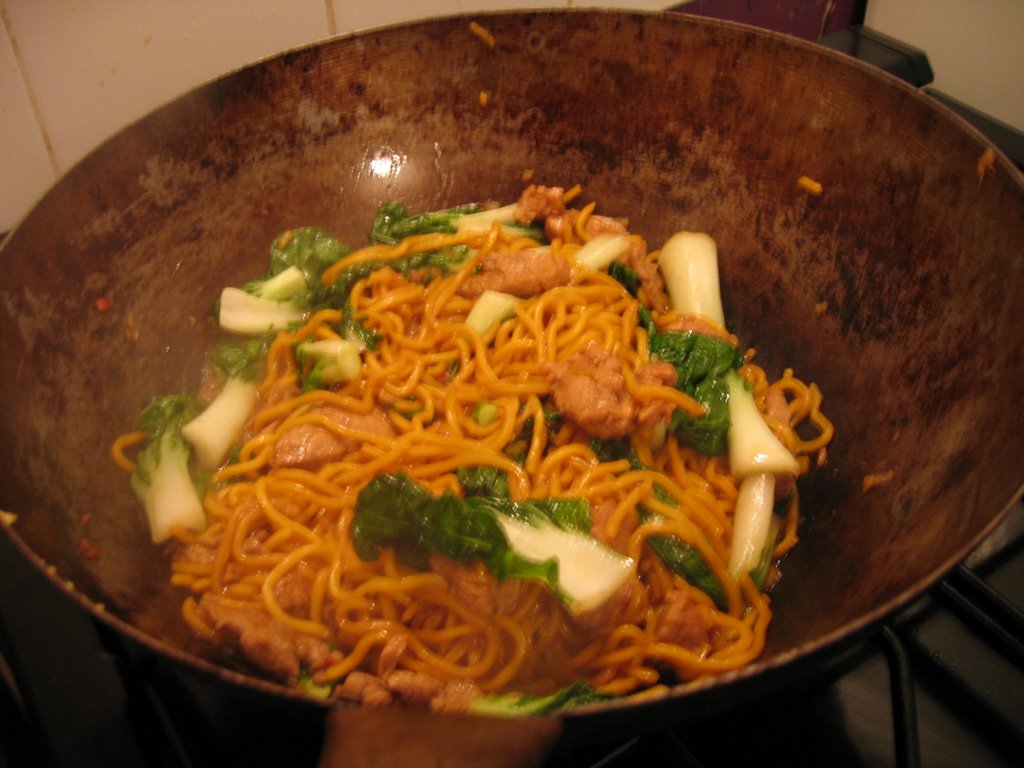
Heat the oil in a wok till smoking then add garlic, ginger and chilli sauce and stir fry briskly till aromatic then toss in the meat and continue to stir fry till it loses its pinkness, 2 or 3 minutes. Add the soy and stir briefly then toss in the noodles and the water and stir to combine. When the wok begins to simmer, cover and reduce the heat for 5 minutes. Take off the lid, increase the heat and add the bok choy and the oyster sauce and stir fry till the greens are wilted. Turn off the heat and add coriander and sesame oil, mix through and serve immediately in deep bowls.

From getting the pan out to steaming hot serving in 20 minutes - bliss. The above makes generous servings for 2 people but I was home alone - the man was eating steak sandwiches in Hong Kong - so I had the rest cold on Monday for my lunch. I wasn't sure it would be edible but I'm pleased to say it was fabulous.


Tuesday, March 13, 2007

Rice Noodles with Pork and Cabbage


medium rice sticks = Thai flat rice sticks = dried rice noodles = rice fettuccine = Mekong rice stick = ban pho (Vietnamese) = banh pho (Vietnamese) = ho fun (Chinese) = hor fun (Chinese) = haw fun (Chinese) = lai fen (Chinese) = laifen (Chinese) = sen lek (Thai) = kway teow (Malaysian) = kway tio (Malaysian) = gway tio (Malaysian) = kui teow (Malaysian) = kuey teow (Malaysian)

Thanks to the Cook's Thesaurus for this wonderful listing of names for dried rice noodles. I could learn it by heart and repeat it like a mantra in the hope of inducing a zen like calm.
I have always found it confusing when I'm shopping in Asian food stores - I think something looks like the thing it is I want to buy but deep down I don't really know. The name on the packet is diffferent to the one I have carefully noted before I went shopping and I get anxious about whether it is the right thing. And if it's not - how will I know? I do ask whoever I can find who works in the shop if it's the right thing but then if I'm using the wrong name for what they know that it is, even if I'm right then they don't know. You can see how it could all be a disaster.

But not with rice noodles. They are an easy thing to recognise - sold in cellophane packs in different widths they are stiff and white and have a sort of translucency like tissue paper. Made with rice flour and water I suspect they would proabably last forever if they never came into contact with moisture. Once soaked in hot water they acquire a much more substantial entity and become creamy and tender and very slippery. They don't add much by way of flavour to a dish but they do add great texture.

This is a very simple dish - quick and easy. I like the lightness of it as a mid week supper and though the principal ingredients would suggest a very substantial meal in fact it's a great way to use wintery ingredients and serve up a spring like dish. You get lots of flavour and textures and the chilli gives it a kick that seriously brightens your day.


Rice Noodle with Pork & Cabbage

400g/1lb pack dried medium rice sticks
1oog/4oz cooked pork, from cooking bones to make stock, or use raw finely diced pork
1 tbspn minced ginger
3 garlic cloves, crushed
25ml sesame oil
50ml light soy sauce
50ml kecap manis - sweet soy
30ml shaoxing rice wine
25ml fish sauce
30g palm sugar, shaved (use a sharp knife or a grater)
1/2 tspn ground pepper
2 tbspns vegetable oil
1 tbspn chat masala spice powder - from Asian food stores like Taj in Brick Lane in London
6 spring onions, sliced into 1cm/ 1/2 inch pieces
2 small red chillies, deseeded and finely chopped
1 small savoy cabbage, finely shredded
1/2 cup coriander leaves

Put rice noodles into a bowl and cover with boiling water from the kettle, soak for 10-15 minutes till slippery. Then drain.

Combine ginger, garlic, sesame oil, soy sauces, rice wine, fish sauce. palm sugar and pepper in a bowl, then add shredded pork and marinate for 10 minutes.

Heat your wok, add vegetable oil and fry chat spice powder for just a moment then stir in the pork and its marinade. Toss over a high heat for a couple of minutes. Add noodles, spring onion, chilli and cabbage and toss over a high heat.

Mix in the chopped coriander and serve immediately in big bowls.

Delightful.

Thursday, December 14, 2006

Grilled Pork and Noodle Soup


Otherwise known as pork chop soup. This started around the time that Wagamama started in London. I really liked their noodle soups - the way they somehow got a whole meal into a large bowl that firstly was visually arresting when it was served while giving off an intriguing aroma and then was full of contrasting flavours and textures so that each mouthful was different from first to last. Initially I just ate at Wagamama a lot. Then I started tinkering at home to make my own versions and discovered that not only is this soup easy to make, there are endless variations around the basics of stock, noodles, greens and a poached egg.


The recipe below is last nights version.

Grilled Pork & Noodle Soup

2 pork chops
800ml/1 1/4 pts stock
250g/ 1/2lb chinese greens like bok choy
1/4 savoy cabbage, shredded
1 tbspn olive or peanut oil
1 tspn sesame oil
200g/ 6oz dried egg noodles
2 eggs
small bunch coriander, chopped

Season the pork chops and put under a medium grill, turning occasionally till cooked. At the same time, heat half the oil in a large saucepan, wash the bok choy and add it, with any water clinging to the leaves, to the hot oil. Cover with a lid and cook till just wilted. Drain in a colander and set aside. Heat the other half of the oil, wash the shredded cabbage and add it to the hot oil and cover and cook till just wilted. Add it to the colander with the bok choy then toss with a little sesame oil. Cover with the lid from the pan and set aside.

Heat the stock to simmering. Add the dried noodles and cook gently for a few minutes. By this time the pork chops should be done - take them out from under the grill and slice. Take the noodles from the stock with a pasta spoon and make a little nest in the base of two large bowls. Turn the heat up under the stock to full. Break an egg into the middle of each nest then ladle boiling stock over them to poach them - they should cook immediately. Arrange the sliced pork and the shredded veg around the egg then top with more stock. Sprinkle generously with coriander and serve.

This makes for a quick supper - it is all done in the time it takes to grill the pork chops. You can use steak or chicken or tofu, grilled prawns would be nice, add chillies and spring onions and fried shallots or garlic slivers or bean sprouts or all of the above, if your bowls are big enough.

Wednesday, August 30, 2006

Grilled Beef and Noodle Salad


Bank holiday weekend - so the weather was bound to be bad - and this belief is enough to make me splash out on steak. Because I love a good steak and any excuse will do. With rump I buy a piece that is thick - at least an inch thick - and it usually comes in at well over a kilo in weight. The steak I bought on Saturday was close to a kilo and a half - serious meat. It is expensive - £17 - but we get two meals from it and the pleasure is sublime.

Cooking the steak is simplicity itself. I heat my ridged cast iron pan on the highest flame for at least five minutes, then season the meat, cut it in half and put the pieces into the pan. Cook on the high heat for 4-5 minutes each side, then turn off the heat and leave the steak in the pan for another 5 minutes to rest. It will be seared on the outside and fairly rare in the centre. Serve with salad and a glass of red. Bliss.

But a lot of meat - too much in fact to eat in a single meal. Next day, the leftovers make a brilliant salad with noodles and a sweet salty dressing that comes from the brilliant book Spice by the Australian chef Christine Manfield.

Grilled Beef & Noodle Salad

12 cloves garlic, peeled
vegetable oil
2 tspns white sesame seeds
4 little Japanese aubergine
500g fresh egg noodles
1/4 cup mint leaves shredded
1/4 cup thai basil leaves, shredded
3 spring onions, finely sliced
2 cups watercress sprigs
leftover grilled rump steak, thinly sliced

Soy dressing
20 ml light soy sauce
1 tspn sesame oil
20ml lemon juice
25 ml Chinese rice vinegar
35 ml mirin
30ml sugar syrup (heat equal quantities of caster sugar and water till dissolved)
2 cloves garlic, minced

Shallow fry garlic cloves in oil until golden and soft, then drain on paper towels. Dry roast sesame seeds over gentle heat until just coloured, then cool. To make the dressing combine all the ingredients and whisk together.

Quarter the little aubergines lengthwise, score the flesh and brush with oil (I use the garlic oil from the previous step) then grill until softened and golden.

Cook noodles in boiling salted water for 2 minutes, drain and refresh. Put the noodles into a bowl with half the dressing.

In another bowl, mix garlic cloves with the herbs, spring onions and watercress then add the meat and spoon in enough dressing to coat leaves and beef lightly.

Pile noodles into bowls, sit grilled aubergines on top. Arrange beef and salad over this then drizzle over a little more dressing and sprinkle with sesame seeds. Serve immediately.

Fabulous.

Wednesday, August 16, 2006

Stir Fry Pork & Noodles


One of the few omissions at Borough Market is a supplier of Asian ingredients, or indeed any non European basics. French, Italian, Spanish, Polish are all well represented and catered for but the wider world isn't really. You can of course buy chillies and ginger and coriander and any cut of meat you need but it's the other bits - fresh slithery egg noodles, shaoxing wine, delicate grains of basmati rice, treacly dark soy that are indispensable to the process of making Asian dishes.

I tend to shop for what I need either in Chinatown on the edge of Soho where the choice is huge to the point of overwhelming or else in the Chinese supermarket in Atlantic Road on the edge of Brixton market. I love roaming the aisles of Lee Ho Fook and New Moon because there are always so many things I have never tried and have maybe heard of and many more that I have never even heard of - so I'll have new things to look for in recipes, to make other connections. And then my cooking and food knowledge evolves. I was in Brixton Saturday afternoon so I spent a happy half hour browsing, then bought a few essentials, as well as tofu and noodles for some dishes I was planning for the week.

I love eating Asian food - it has a whole other range of perfumes and textures and flavours and is somehow delicate and robust simultaneously. I enjoy cooking Asian dishes - they are different to most European dishes with so much preparation being able to be done first then often really quick cooking times with flavour coming from marinades and aromatics rather than slow cooking making it an easy option mid week after work and a treat always.

Stir Fry Pork & Noodles

350g/12oz pork fillet, thinly sliced
1 tbspn shoaxing wine
1 clove garlic, crushed
1 red chilli, chopped finely
1 tbspn ginger, grated
2 tbspn groundnut oil
1 tbspn dark soy
2 tbspn fish sauce
1/2 cup water
500g packet of fresh egg noodles
500g pak choi
1 tbspn oyster sauce
3 spring onions, green part chopped
Handful fresh coriander, chopped

Soak the sliced pork in the rice wine while you chop the rest of the ingredients. Rinse the noodles in a colander to separate them. Separate the leaves of the bok choy and rinse. It is best to prepare everything before you start cooking. Heat the oil in a wok over a high heat till very hot, briefly stir fry the chilli, ginger and garlic then add the pork and stir fry till the meat changes colour. Add the noodles, soy and fish sauce, stir to coat everything, then add the water. When it simmers, reduce the heat, cover and cook for 4-5 minutes.

Uncover the noodles, return the heat to high and add the pak choi and the oyster sauce. Stir fry till the leaves wilt then toss through the spring onions and coriander and serve immediately.


Fabulous supper with less than 10 minutes cooking.

Tuesday, May 23, 2006

Asparagus

Everywhere you look at the moment there are food items headed 'What to do with asparagus' and I'm not sure why. The obvious thing to do with asparagus is eat it as fast as possible with as litttle adornment as possible because it is truly one of the worlds great vegetables. In fact at this time of year in England it is THE greatest vegetable. The brevity of its appearance adds to its desirability - that 6 week window is over all too soon. We've eaten it each weekend for the last few weeks simply steamed for 6-7 minutes with a little grinding of black pepper and a knob of butter. It's nice with the addition of an egg - poached or fried - some crusty bread to mop up any juices perhaps.

For such a delicate vegetable it really is quite robust. The best way to eat only the tender part of the stalks is to break each stalk where it snaps - the top piece should be cooked and enjoyed immediately.

This week as a little change I made a stir fry. We had some rare grilled rump left over from dinner Saturday, so the slight edge of charring on the meat and the delicate crispness of the asparagus mixed through soft noodles made for a heavenly marriage. This could easily be made with chok boy at other times of the year.

Stir fry beef and asparagus

250g/1/2lb rump steak, thinly sliced
1 bunch asparagus, chopped into 3cm/1" pieces, tips kept separate
1 small red chilli, finely chopped
1 garlic clove, crushed
1 tablespoon grated fresh ginger
500g/1lb fresh egg noodles
2 tbspns light soy sauce
1 tbspn oyster sauce
1 tbspn vegetable oil
1/2 cup chopped coriander
2 spring onions, finely sliced

Heat the oil in a wok and, when it is very hot, add the chilli, garlic and ginger and stir fry briefly till fragrant. Add the asparagus stalks, toss to coat in the spicy oil then add the soy sauce and 2 tablespoons of water, lower the heat, cover and cook for 4 minutes. Raise the heat again and add the meat, stir briefly then add the noodles and toss together for a minute or so.

Add the tips of the asparagus and the oyster sauce and stir through till everything is hot. Add the coriander and spring onions, mix thoroughly and serve immediately in big bowls.