Showing posts with label Stir-fries. Show all posts

Thursday, August 14, 2008

Carrot & Ginger Stirfry


Ginger is a fabulous thing in all its forms, bringing hot sweetness to any dish it is added to. Fresh, it's a fairly ugly looking root, all gnarled and knobbly, making it difficult to peel. Though I have discovered that it is simplicity itself to peel using the edge of a teaspoon. Try it - works every time.
I use masses of it fresh - mostly for flavour in stirfries and curries and as the essential ingredient in dal. I also like it grated into a pot of rhubarb before it cooks, it goes well with the tart sweetness. As a kid I loved the big tins of melon and ginger jam my mother used to buy - though it is many years since I have seen such a thing. Bring it back, I say, if it tastes as good as my memory recalls.

Idly checking a few web pages for a little nugget of something about ginger I came across the source of the phrase ' to ginger up'. It comes from times when slightly unscrupulous horsetraders would insert a nugget of peeled ginger into the anus of an old horse they were trying to sell. The resulting minor irritation would cause the animal to prance about with its tail up and head held high just like a much younger horse. Presumably it's also where 'geeing up' comes from too!

The recipe comes from BEYOND THE GREAT WALL BY Jeffrey Alford and Naomi Duguid. I was struck by it when I first read it because of the sheer amount of ginger - it is one of the major ingredients rather than the usual flavour enhancer. I was intrigued by the sound of it and liked the idea of the visual vibrancy of the orange/gold combination mimicking the kick of the sweet spiciness. Turns out it was all this - and more.

Carrot and Ginger Stirfry

2 tablespoons peanut oil or lard
1 tablespoon minced garlic
100g ground pork
3 dried red chillies
350g carrots, peeled and cut into matchsticks (1 3/4 cups)
150g ginger, peeled and cut into matchsticks (1 cup)
1/2 teaspoon salt
1 cup water
10 to 12 Sichuan peppercorns, lightly crushed or coarsely ground
2 tablespoons soy sauce, or to taste

Heat a wok or wide heavy pan over high heat. Add the oil or lard and swirl to coat the bottom of the pan. Toss in the garlic and stir-fry for 10 seconds or so, then toss in the pork and chillies. Stir-fry, separating the pieces of meat so all get exposed to the hot pan, until they have started to change color all over, less than 2 minutes.

Toss in the carrots and ginger and stir-fry for about a minute. Add the salt and stir-fry for another minute. Add the water, cover, and boil vigorously for about 3 minutes, then remove the lid and let the liquid boil down for a minute or two. Add the Sichuan peppercorns and soy sauce. Stir-fry for another minute, or until the carrots and ginger are tender but still firm.

Turn the stir-fry out onto a shallow bowl and serve hot or warm.

Leftovers cold next day for lunch worked a treat.
Granted it is probably not a recipe title that instantaneously gets the gastric juices flowing but don't be deceived. This is a great dish on so many levels. It is quick, clean, crisp, easy to make, you can eat it hot, warm or cold - and next day for lunch. It is really attractive to look at, smells divine and has lots of interesting textures in your mouth. Not sold? It is the kind of dish that I will almost always have the ingredients for - a few carrots, a large lump of fresh ginger, some cloves of garlic. I also keep little packs of minced pork in the freezer in 50-75g lumps for a whole variety of asian dishes - a trick well worth emulating if you cook lots of Chinese food. So for me this is a great mid week treat - on its own with rice or with another dish, which can then be a bit more finicky as your attention won't be dragged away at a critical moment.

Thursday, April 03, 2008

Stir Fry Egg Noodles with Chicken and Thai Basil


I am a seriously big fan of stir fry noodles - I suspect it would be impossible for me to ever tire of their myriad forms, flavours and textures. They are a bowl of endless slithering surprises, cheering to eat any time. Midweek they make a fine quick supper.

Saturday night we had big thick rump steaks chargrilled with nothing more complicated than green salad and crusty bread. Being the greedy feaster that I am I had bought a very thick slice of meat as I find it cooks best in a grill pan when the outside caremalises on the highest possible heat and the center stays rare. But this method means we had more steak than we could actually consume in one meal. Sunday night I decided on salad - noodles with strips of rare grilled beef mixed with cucumber and spring onions and a big handful each of coriander and thai basil simply dressed with a sesame/soy mix. Loved it. It did mean though that I had half a bunch each of coriander and thai basil in the fridge and it seemed a shame to waste them.

Thai basil is such an interesting and distinctive herb. It is of the basil family but not really as we know it in Europe. It has lush, deep green leaves that appear to be almost polished, purplish flower buds and stems with lovely anise overtones to its sweet basil scent. In many asian dishes it is added by the handful in whole leaves, to green and red curries and spicy stir-fries dishes. It is different to holy basil, which has smaller slightly hairy leaves though I have been known to use one in place of the other. You just end up with a different flavour.

I had a chicken breast in the freezer from a couple of weeks ago as well as a pack of egg noodles so all put together with a few other bits from the fridge from this week's shop we had a quite splendid repast Wednesday night.

Stir Fry Egg Noodles with Chicken and Thai Basil

1 chicken breast, about 250g in weight
1 tspn sesame oil
!/2 tspn salt
1 tspn shaoxing rice wine
2 tspns light soy
4 tbspns peanut oil
400g fresh egg noodles
1 tbspn ginger, finely chopped
2 juicy cloves of garlic, finely chopped
1 tspn chopped chilli, preserved if you have any
1 small green pepper, sliced into thin slivers
3 spring onions, green and white parts sliced into thin slivers
1 tbspsn light soy
I cup thai basil leaves
1 cup coriander leaves, chopped

Slice the chicken into thin strips then leave to marinate in the next four ingredients.

Rinse and drain the noodles in cold water. Heat your wok then add 2 tablespoons of the oil. When the oil is hot add the noodles and stir fry till hot and fragrant. Take them out of the wok and put into a bowl. Return the wok to the heat and add the rest of the oil. When it is hot add the chicken and its marinade. Stir fry over a hight flame for a few minutes till the chicken changes colour and is cooked. Add the ginger, garlic and chilli along with the pepper strips and spring onions. Continue to stir fry for a couple of minutes till everything is hot and fragrant.
Return the noodles to the pan with the soy sauce and toss to mix well. When everything is bright and smelling wonderful toss in the herbs, incorporate quickly and then serve in big bowls.

So fast. So fabulous.

Thursday, January 31, 2008

Stir Fry Pork, Cabbage and Tree Ears


Made a stir fry last night. What was interesting about the recipe from Mrs Chiang's Szechwan Cookbook, initially, was that it combined pork and cabbage and so ticked my boxes for a winter supper. As I started to prep it I realised that it contained no garlic or ginger, and the only onions were sliced scallions and there was no mention of scatterings of fresh coriander anywhere. The egg noodles were my idea rather than a requirement. All my strong held preconceived notions about absolute requirements for a dish to be chinese proved wrong.

Needed to soak things and marinate things to get the process started. When I announced that I was off to the kitchen to soak some tree ears the man laughed at me. Checked that I didn't really think trees had ears. But I had a packet of dried ones in the larder - so I knew better! Wood ears or tree ears are a kind of jelly fungus that is particularly popular in Szechuan cooking. Used for its texture it is a crucial element of this cuisine.

In the wild the wood ear fungus does strongly resemble an ear, as it forms folds and whorls while it grows on the trunks and bark of mostly dead trees. Like other jelly fungi, it tends to jiggle slightly when fresh or rehydrated, and has a slightly crunchy, slightly rubbery texture which is retained even after cooking. It is relatively tasteless but rather soaks up the liquid flavours of the other ingredients. The Shanghainese Hot and Sour Soup must include shredded wooden ear to have the right texture. Adding wood ear to braised meat dishes enhances the flavor. Using it in vegetarian dishes adds an extra shine to the dish, thickens the sauce and makes everything more flavorful. Magical.

Once the fungi are soaked this is a spectacularly quick dish to make. The only thing I would do differently next time is cut the pork much more finely. I was being lazy and didn't follow the guide to make each piece the size of a matchstick which would really have made this even better because it is about finding the perfect balance of texture to flavour.

Stir Fry Pork, Cabbage and Tree Ears

1/2 cup tree ears - buy them dried in chinese supermarkets
4 large dried black mushrooms, buy them at the same time as the tree ears
350g/3/4lb pork steak
2 scallions
3 tablespoons soy
4 teaspoons sesame oil
1 1/2 teaspoon cornflour
1/2 small head of cabbage
7 tablespoons peanut oil
1 1/4 teaspoons salt
500g fresh egg noodles

Put the tree ears and the mushrooms into a small bowl, cover with boiling water and leave to soak for at least 20 minutes. Cut the pork into shreds the size of matchsticks - put the meat in the freezer first for 10 minutes to make it easier to slice and also ask your butcher to slice it thinly when you buy it. Put the meat shreds in a bowl.

Clean the scallions then slice both green and white parts into slivers approximating the pork slivers. Add them to the meat long with the soy and two teaspoons of the sesame oil and the cornflour. Mix well.

Peel off and discard the outer leaves of the cabbage then slice it into shreds as though about to make coleslaw.

Drain the tree ears and mushrooms. Rinse the tree ears very carefully under cold running water, picking them over to remove any impurities like little bits of wood still sticking to them. Slice them into shreds the same size as the other ingredients. Rinse the mushrooms, remove their tough stems and then shred them. Keep them separate from the tree ears. Rinse the noodles in a colander under a cold running tap to separate them.

Heat your wok or pan over a high flame for 15 seconds then add 2 tablespoons of peanut oil. When it is just at the point of smoking add the cabbage, stir fry for about 45 seconds, then add the salt and continue to stir fry for another minute. Remove it from the pan to a bowl.

Wipe out the wok then reheat over a high heat for a few seconds. Pour in the rest of the oil and, when the first few bubbles appear add the mushrooms. Stirfry for 30 seconds. Add the meat/scallion mix and a tablespoon of water and stir fry till the meat changes colour. Add the noodles and stir fry till all is hot - add a little more water if necessary. Then add the wood ears and stir fry for another 90 seconds.

Finally return the partially cooked cabbage shreds to the pan. Stir fry everything for about 3 minutes till the meat is cooked and the cabbage is still bright green. Turn off the heat, stir through the last of the sesame oil then serve immediately in large bowls.


Utterly amazing.

Thursday, May 31, 2007

Spicy Aubergine Pot

I am often seduced by the shiny blackness of aubergine, thrilled by its multitude of uses and the number of culinary frontiers it crosses effortlessly. I can buy them randomly without having a specific plan and if takes me half the week to think what to do with it it will still be fresh and edible tucked away in the vegetable drawer in the fridge. The creamy smoky flesh remains distinctive and yet is the centrepoint of dishes as diverse as the Lebanese baba ganoush or the Chinese sea spice aubergine. I wasn't always so fond - my first experience of eating this extraordinary vegetable was a badly made greek dish - slimy, oily and overwhelmingly grey it was much more mouse-acre than moussaka. Took me years to give them another go.

As a vegetable they are obviously seasonal but I was vaguely surprised to find they are grown extensively in the UK. Though they are piled high at this time of year I had thought they come from warmer climes, seeming as they do to contain edible sunshine. In fact they are not even a vegetable but rather a berry - Solanum melongena. That is the useless information for the day that may win you the £1 million. They have been cultivated in parts of Asia since forever and became known in the West after 1500.

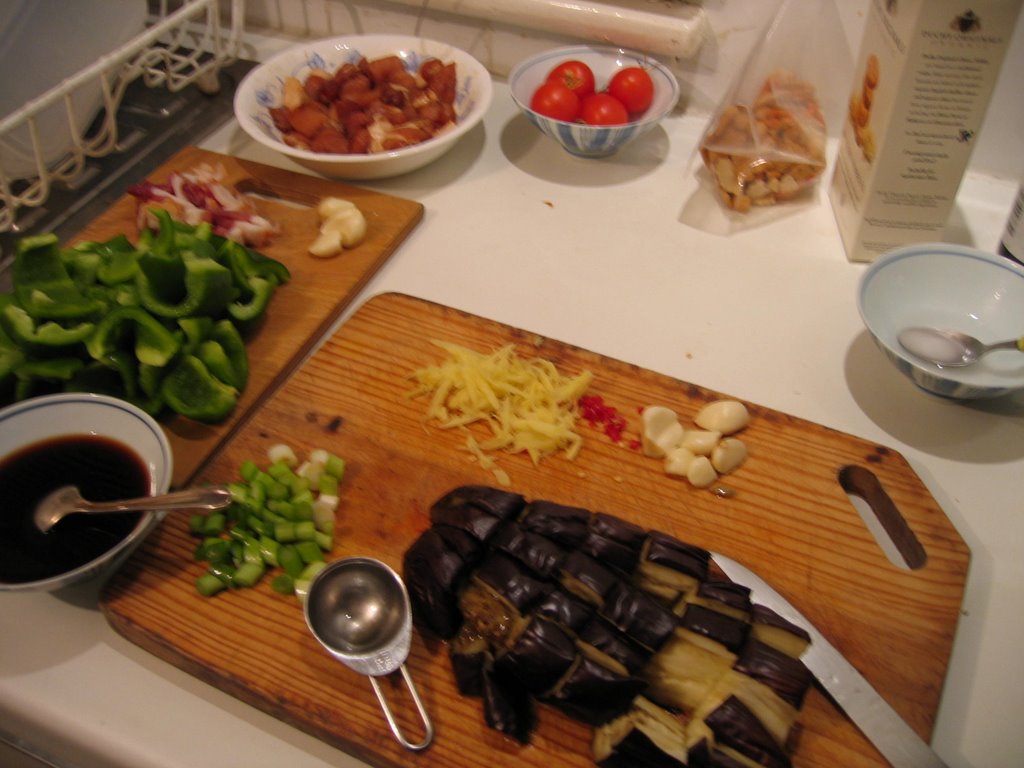
This recipe comes from the wonderful Fuchsia Dunlop's Revolutionary Chinese Cookbook. Though not very quick to make it is easy peasy and lovely to eat. The aubergine is soft and creamy, and having been salted first it takes up little of the oil, there is the sweet heat of ginger and the prickle and glow of chilli; the pork adds a salty firm chewiness like a scattering of roughness against your tongue, its inclusion in the dish as much for its texture as its flavour. That is one of the things I really love about some Asian food, the way that texture is as integral to the dish as perfume and flavour creating a more interesting and pleasurable experience.

Spicy Aubergine Pot
1 large/2 small aubergine
salt
2 dried shiitake mushrooms, soaked in boiling water for 30 minutes
75g/2 1/2 oz minced pork (I used finely diced ham as I had no pork and it was good)
2 tbspn chilli bean paste
2 tspn grated fresh ginger (I made a typo at first listing grated finger not ginger - often true!)
2 tsp finely chopped garlic
150ml chicken stock or water
1/2 tspn dark soy
2 spring onions, green parts only, finly sliced
1 tsp sesame oil
groundnut oil for deep frying

Peel the aubergines, cut them in half lengthways and then crosswise. Cut each quarter into chunks, sprinkle with salt and leave to drain for about 30 minutes. Meanwhile, drain the shiitakes and squeeze dry. Finely chop them.

Rinse and pat dry the aubergines. Heat the oil for deep-frying in the wok over a high flame then fry the aubergine for a few minutes till they are tender and tinged with gold. Remove with a slotted spoon and drain on kitchen paper. Do this in batches till it is all cooked.

Drain off all but 3 tablespoons of the oil and return the wok to a high flame. Add the pok (ham) and stir fry as it separates and loses its water content. Add the chilli bean paste and stir fry till the oil is red. Add the ginger, garlic, shiitakes and chilli and sizzle till they are wonderfully fragrant. Pour in the stock, add the dark soy and the cooked aubergines and simmer on a medium heat for a few minutes to allow the flavours to penetrate the aubergines. Season if necessary.

Finally, turn up the heat to reduce the sauce a little. Add the spring onions and stir-fry until barely cooked. Remove the wok from the heat, stir in the sesame oil and serve. With rice and another dish, perhaps tofu or peppers and black beans.

Very good cold for lunch next day.

Friday, February 02, 2007

Peppers Stir fried with Black Beans


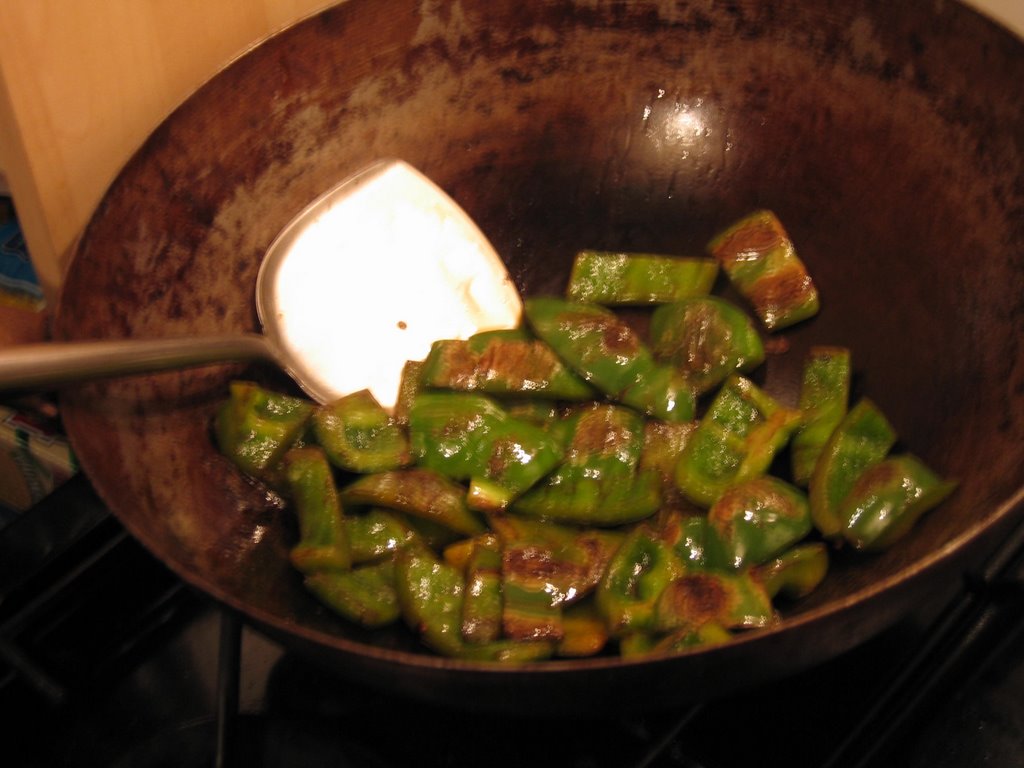
This is a very simple dish that is quick to make, cheap and a perfect balance of flavours and textures. The green peppers have a slightly sourish unripe note, red pepper is sweeter and the salt from the black beans cuts through the sweetness and gives a rich, more balanced flavour. The peppers, once cooked, still retain a little bit of crunch but it is wrapped inside the silky flesh. They go well with most stir fries or plain boiled rice and are really lovely cold the next day. No prizes for guessing the original recipe came from Fuchsia Dunlop's Revolutionary Chinese Cookbook.


Peppers and Black Bean Stir-fry

1 red, 1 green, 1 yellow pepper

3 cloves garlic, thinly sliced

1 tbspn black fermented beans, rinsed

1/2 tspn clear rice vinegar

salt

2 tbspn stock or water

1 tspn sesame oil

1 tbspn ground nut oil

Cut the peppers in half, discard the seeds and stems and cut into large squares. Heat the oil in a wok over a medium heat. Add the peppers and stir fry for 5-6 minutes, until they are tender and their skins puckered and a little golden. Remove the peppers with a slotted spoon and set aside.


Return the wok to a high flame. Add the garlic and black beans and stir fry till fragrant. Return the peppers to the wok and season with the vinegar and salt to taste. When everything is sizzling and delicious, stir in the stock or water, and then, off the heat, the sesame oil.


Serve with white rice and another dish, in this case home cooked pork.


Yum.

Thursday, January 11, 2007

Home Style Bean Curd


Tofu - bean curd - is made in much the same way that cheese is made. Soy milk, made by soaking, grinding, boiling, and straining dried soybeans, is curdled by the addition of a coagulant - either acid or salt that leave no perceivable trace of taste - and the resulting curds are then pressed to form blocks. Though it is known that tofu originated in China, anything more exact about its origins than that is, like the origins of cheese, lost in the mists of time.

Rich in protein, and also calcium if produced traditionally using calcium sulfate, it is hugely versatile. It can be eaten raw, simply dipped in something flavourful like soy and chilli flakes or with a little pale pink pickled ginger. It can be shredded into soup or firmed up with a brief meeting with heat then stir fried with intense or fragrant sauces. Deep fried, it puffs up into light gold crusted clouds that will take up the juices of stocks and perfumes of spices. There is little to taste with tofu on its own - in fact bland is a good word - making it ideal to partner with both strong and subtle flavours. If it seems sour or the water it is packed in is cloudy then it has gone off and will be unpleasant.

The first few times I attempted to cook with it were disastrous. I bought what I know now to be silken tofu - which has the highest water content and is like a fine set custard - and it simply disintegrated whenever I went near it and dinner ended up as sandwiches. Not entirely defeated but definitely wary I still ate it often in restaurants and wondered at what alchemy they used to stuff it or stir fry it in lovely chunks. Then, after I spent some time reading the detailed information in Fuchsia Dunlop's book, I decided it could be time to try again. And finally, armed with a little more knowledge, it worked.

The very first time I cooked an edible meal that included a tofu dish I was thrilled - it was like unlocking a secret code. Having made a few different tofu dishes occasionally over the last few months, I feel like I have made tangible progress in the kitchen. I have a new ingredient that I can use well. This time I was even confident enough to make a few changes to the original recipe and still it worked.

Home Style Bean Curd

2 dried shiitake mushrooms
1 block of firm bean curd, drained, about 550g/1 1/4 lb
2 thick rashers of smoked bacon, cut into fine slices
1 tsp shaoxing wine
1 tbspn chilli sauce with fermented black beans
1 tbspn finely chopped garlic
1 tspn dried chilli flakes
200ml/7 fl oz light chicken stock
1/4 tsp dark soy sauce
salt
3/4 tsp potato flour mixed with 1 tbspn water
3 spring onions, green parts only sliced
1 tsp sesame oil
6 tbsp groundnut oil

Put the dried mushrooms in a bowl, pout over enough boiling water to cover and leave to soak for 30 minutes. Drain, squeeze dry, cut out and discard the stalks and slice the caps thinly. Set aside.

Put the bacon slivers into a bowl and mix with the Shaoxing wine.

Cut the bean curd into large squares and then cut these into triangular slices about 1cm/1/2 inch thick. Heat the wok over a high flame until smoke rises then add 3 tablespoons of the oil. Lay the bean curd on to the surface of the wok and fry, turning over once, until golden on both sides. Drain on kitchen paper and set aside. You may need to do this in a couple of batches.

Clean the wok if necessary and re-heat over a high flame then add the other 3 tablespoons of oil and swirl it around. Add the bacon and stir fry until the slivers separate. Add the chilli paste and stir fry till fragrant. Throw in the garlic and mushrooms and continue stir-frying until it smells divine. Finally add the chilli flakes, stir briefly then pour in the stock.

Return the bean curd to the wok with the dark soy sauce and bring to the boil. Reduce the heat and simmer for several minutes to allow the flavours to penetrate the bean curd, seasoning with salt to taste.

Add the potato flour mixture and stir to thicken the sauce, then add the spring onions. Finally, off the heat, stir in the sesame oil and serve.

We had this with steamed basmati rice and pounded aubergine and green peppers. Don't be put off by the length of the instructions - it is straightforward and pretty quick and definitely a great dinner. For a vegetarian version, omit the bacon and use vegetable stock - but I'd still throw in the little bit of wine.

Tuesday, January 09, 2007

Spiced Millet & Stir Fried Broccoli


Those of you who know many things will know that millet is used as bird seed. And despite the fact that I am not a budgerigar millet is what I cooked last night for supper. The reason for this slip off the path of the already tried and tested is a plea for help from my friend David. He's a healthy type who teaches Pilates and generally looks pretty amazing despite a penchant for fabulous cake. But what with new year and resolutions and the usual desire to generally be better that strikes us all in January he decided to sort out his diet. He took himself off to see a man who gave him a plan and included in this plan was millet as the grain of choice. Clueless as to its uses he came to me, assuming that my vast repertoire would run to recipes for millet. Except that all I knew about was the bird seed.

Doing a little research turned up a lot of information - it is a grass seed grown in Europe, the States and Australia as a cover crop, for livestock feed as well as for the birds, whereas in Asia and the Middle East it has been cultivated and eaten since prehistoric times and, initially, was probably more important than rice as a crop. It is still used as a source of flour in India and, suited as it is to growing in hot dry climes, it is an important staple in some of the poorest areas of Africa where it is used to make bread and the whole grain is cooked to make porridges and stews. Millet is also the basis for the brewing of some African beers.

David told me that he had looked in the supermarket and in Holland & Barret without success for packs of millet so it seemed that even finding it could turn out to be tricky. As with all things food my first stop was Borough Market and there, on the shelves of Total Organics, I found not only tiny golden millet seed but also flour. This was progress. Most of the uses I could find for it involved either making muesli or simply boiling it to use instead of rice - nothing that sounded wildly interesting. In fact generally a fairly cheerless collection - healthy with an added dash of hair shirt. After my experience of playing around with quinoa I was hoping to do something of the same with millet. When I'm aiming to cook lightweight food I find find spicy is best and that fitted in to the whole healthy point of this exercise.

So I started with the notion of Chinese/Indian and found that toasting the grain in oil with lightly cooked spices before steaming it and then serving it with the simple clean flavours of stir fried broccoli produced a quite wonderful dinner. Simple, quick and it's good for you. Perfect January food.

Spiced Millet

1 cup millet
1 tbspn sesame oil
1 tspn cumin seeds
1 tspn brown mustard seeds
1/2 onion, finely chopped

1 3/4 cup water or stock
¼ tspn salt

Rinse the millet with water and set aside to drain. Very gently heat the sesame oil in a heavy based pan and add the cumin and mustard seeds. Sauté for 10 seconds, until the mixture is aromatic. Add the onion and sauté for 5 minutes then add the millet and sauté for another 5 minutes.


Bring the stock or water to a boil then add it with the salt to the sauteed millet mixture. Reduce heat and simmer for 20 minutes or until all the liquid is absorbed. Remove from heat the let rest for 10 minutes then fluff with a fork and serve with the stir fried broccoli.

Stir Fried Broccoli

500g/1 lb broccoli cut into florets
A large knob of fresh ginger, peeled and grated
1 small red chilli, finely chopped , seeds discarded if you don't want it too hot
3 cloves garlic, peeled and crushed
1 tbspn olive oil
2 tbspn water
1 tbspn fish sauce
1/2 tbspn oyster sauce

Heat the oil then fry the ginger, chilli and garlic till soft and fragrant. Add the broccoli and stir till coated then add the liquids and stir to incorporate. Bring to the boil then cover, reduce the heat and cook for about 5 minutes till the broccoli has softened but still retains a bit of crispy bite. Serve over spiced millet.

Wednesday, November 01, 2006

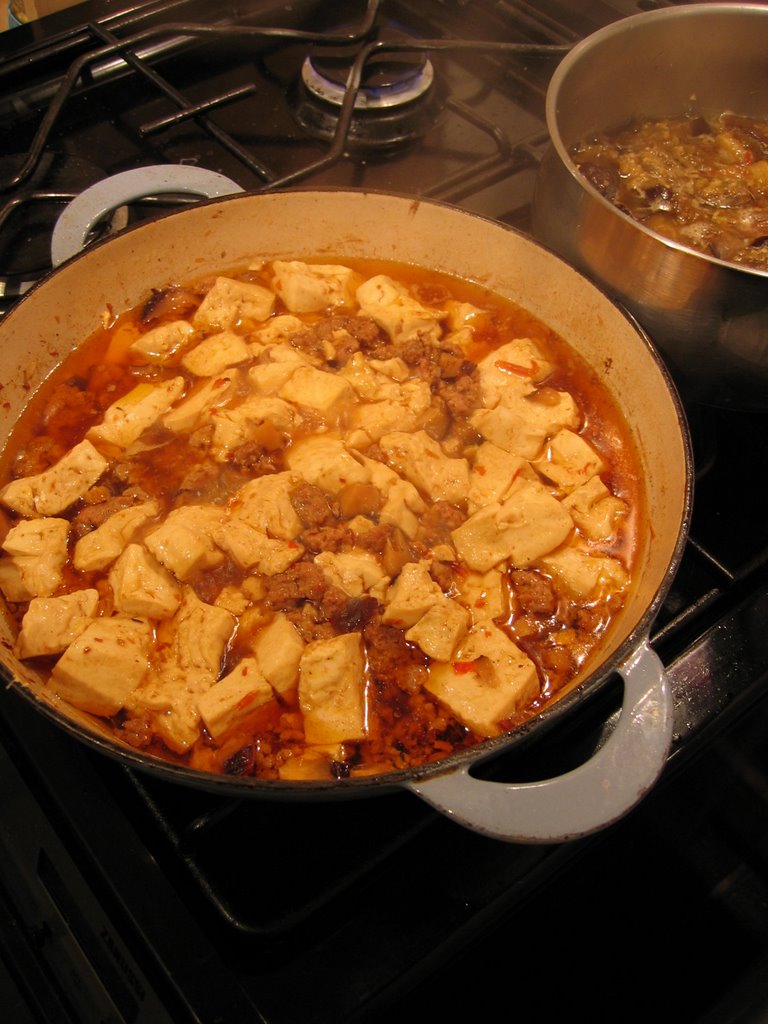
Pock-Marked Woman's Bean Curd


Great name for a dish, no? I find it irresistible as apparently did the local Hunanese in whichever of the myriad versions of how the dish acquired its name. A common version is that Ma Pó was a poor woman badly scarred by leprosy who lived on the outskirts of Chengdu at some time between 1800 and last month who survived by hawking this wondrous combination of silky bean curd, minced pork (or in some versions beef or lamb) and vast amounts of chilli and a final spicing of crushed szechuan pepper before serving.

Another version has it created in the first year of the Tongzhi reign (1862) of the Qing Dynasty by Chen Xingsheng Restaurant. The main chef was the wife of Chen Chunfu whose name has been lost in the mists of time, but was known then - and now - for her pockmarked face, a result of small pox, hence the name. She is said to have prepared this spicy, aromatic dish for labourers who laid down their loads of cooking oil to eat lunch on their way to the city's markets. Later the restaurant was renamed as the Pockmarked Chen Grandma's Bean Curd Restaurant, which became famous far and wide.

It was one of Mao Zedong's favourite dishes. Mao's successor, Deng Zhou Peng loved it too, preferring it with equal quantities of chilli and pork - he's a braver man than me!

This version comes from Fuchsia Dunlops 'Sichuan Cookery'.

Pock-marked Mother Chen's beancurd 'ma po dou fu'

1 block of beancurd (about 500g)
4 baby leeks or spring onions
100ml groundnut oil
150g minced beef or pork
2½ tablespoons Sichuanese chilli bean paste
1 tablespoon black fermented beans
2 teaspoons ground Sichuanese chillies (only for chilli fiends)
250ml vegetable stock
1 teaspoon white sugar
2 teaspoons light soy sauce
salt to taste
3 tablespoons potato flour mixed with 4 tablespoons cold water
½ teaspoon ground roasted Sichuan pepper

Cut the beancurd into 2cm cubes and leave to steep in very hot or gently simmering water which you have lightly salted. Slice the leeks or spring onions at a steep angle into thin 'horse-ear' slices.

Season the wok, then add the groundnut oil and heat over a high flame until smoking. Add the minced beef and stir-fry until it is crispy and a little brown, but not yet dry.

Turn the heat down to medium, add the chilli bean paste and stir-fry for about 30 seconds, until the oil is a rich red colour. Add the black fermented beans and ground chillies and stir-fry for another 20-30 seconds until they are both fragrant and the chillies have added their colour to the oil.

Pour in the stock, stir well and add the drained beancurd. Mix it in gently by pushing the back of your ladle or wok scoop gently from the edges to the centre of the wok - do not stir or the beancurd may break up. Season with the sugar, a couple of teaspoons of soy sauce and salt to taste. Simmer for about 5 minutes, until the beancurd has absorbed the flavours of the sauce.

Add the leeks or spring onions and gently stir in. When they are just cooked, add the potato flour mixture in two or three stages, mixing well, until the sauce has thickened enough to cling glossily to the meat and beancurd. Don't add more than you need. Finally, pour everything into a deep bowl, scatter with the ground Sichuan pepper and serve.

Wednesday, October 04, 2006

Sea Spice Aubergine


I first tried sea spice aubergine a few years ago at the recommendation of the owner of a little Vietnamese restaurant we used to frequent. When I asked him what it was he shrugged and said it's nice, you'll like it. He was right. I've had it many times since in other restaurants but could never find a recipe for it. I googled it - my fall back response whenever I need information - but without success. The results are all for takeaway menus from Swindon not recipes to follow at home. I scanned the shelves of Chinese supermarkets and found nothing marked sea spice. I asked but got a blank look in reply.

All very curious.

Then one day I was reading about something else and it mentioned that sea spice aubergine are sometimes called fish fragrant aubergine because the combination of spices is usually used to cook fish dishes. So I googled fish fragrant aubergine and finally got a result - I can't tell you how delighted I was. The recipe I liked the best comes from the Chinese Healthy Living website. I rushed home that night to try it out - and to my delight it was brilliant. I made it again last night with pork and green peppers and steamed basmati rice. It was very very good.

Sea-spiced Aubergines

750g/1 1/2lb aubergine
1/2 tbspn olive oil
4-5 garlic cloves, finely chopped
2 slices fresh ginger root, peeled and finely chopped
1 red chilli, finely sliced
50ml/2oz vegetable stock or water
1 tbspn yellow bean sauce
1 tbspn Chinese rice wine or dry sherry
1 tspn shoyu or tamari sauce 2 spring onions, chopped, to serve

Put the aubergine ina foil-lined roasting tin and bake in teh centre of a preheated oven, 200C/400F/Gas Mark 6, for 30-35 minutes until soft and wrinkly. Remove and set aside to cool, then cut into 2.5 cm/1 inch cubes.

Heat the oil in a nonstick sauté pan over a high heat until hot, add the garlic, ginger and chilli and stir-fry for a few seconds till fragrant. Stir in the stock, yellow bean sauce, rice wine and shoyu sauce and bring to the boil. Add the aubergine cubes and simmer for about 5 minutes. Slowly stir in the cornflour paste and cook until the sauce has thickened and turned transparent.


Sprinkle with chopped spring onions and serve immediately.

Yellow bean sauce and shoyu are probably only available from Asian food stores - or online for mail order if you don't have one locally. This is such a lovely dish that they are well worth hunting down.


Tuesday, September 19, 2006

Stir Fry Pork and Green Peppers


This comes from the new book by Fuchsia Dunlop, The Revolutionary Chinese Cookbook, that I bought recently and have fallen in love with. She is an extremely talented cook and conveys her huge knowledge of Hunanese cooking easily and with great authority. What I love most is learning to cook - successfully - a different kind of cuisine using unfamiliar ingredients. It is so easy to repeat dishes that you know and like and stop looking for inspiration elsewhere. Unfortunately that leads inevitably to that nightmare scenario of reducing life to seven dishes endlessly repeated every night so if it's sausage and mash it must be Tuesday. Don't want to go there.

With food from this region of China I know where I'm headed because I've eaten a few times at the wonderful Hunan restaurant in Pimlico. It helps enormously to have that sense of direction but this is a complex and sophisticated cuisine and you can't hope to understand it without guidance. I have never been able to accurately reproduce these dishes at home which is frustrating because it is some of my favourite food. So it's a great thrill to be able to use tofu and fermented black beans and make an intensely flavoured supper redolent of pleasurable nights out. You will definitely need to visit a Chinese supermarket for some ingredients like fermented beans - they are different to black bean sauce - but that just adds to the adventure.


Farmhouse Stir-fried Pork with Green Peppers

250g/9 oz Green peppers
50g/ 2oz belly pork or streaky bacon
200g/ 7oz lean boneless pork
1 tspn Shaoxing wine
1 tspn light soy sauce
1/2 tspn dark soy sauce
2 garlic cloves, sliced
2 tsp black fermented beans, rinsed
salt
1/2 tsp potato flour mixed with 2 tbspn of stock or water (optional)
About 3 tbspn groundnut oil or lard for cooking

Cut off and discard the stems of the peppers, and slice at a steep angle into 3cm/1 1/4 inch chunks. Cut the belly pork and the lean pork into fairly thin slices; set aside the belly pork. Add the Shaoxing wine and the soy sauces to the lean pork and mix well; set aside.

Smear the wok with a little oil or lard and heat over a medium flame. Add the peppers and stir-fry, pressing them against the side of the wok with your wok scoop for about 5 minutes, until they are fragrant and tender and their skins a little golden and puckered. Remove the peppers from the wok and set aside.

Remove any pepper seeds from the wok, and re-heat over a hot flame till smoke rises, then add 2 tablespoons of oil or lard and swirl around. Add the belly pork and stir-fry until the slices are tinged with gold. Toss in the garlic and black beans and stir-fry briefly until fragrant then add the lean pork. When the pork has almost changed colour and lost most of its water content, return the peppers to the wok and continue to stir-fry for another minute or so, adding salt to taste.

If using the potato-flour mixture - it gives a nice professional gloss to the finished dish - give the mixture a stir and tip it into the wok at the final stage, stirring just long enough for the sauce to cling to the meat.

Serve over fragrant basmati rice.

Wednesday, August 16, 2006

Stir Fry Pork & Noodles


One of the few omissions at Borough Market is a supplier of Asian ingredients, or indeed any non European basics. French, Italian, Spanish, Polish are all well represented and catered for but the wider world isn't really. You can of course buy chillies and ginger and coriander and any cut of meat you need but it's the other bits - fresh slithery egg noodles, shaoxing wine, delicate grains of basmati rice, treacly dark soy that are indispensable to the process of making Asian dishes.

I tend to shop for what I need either in Chinatown on the edge of Soho where the choice is huge to the point of overwhelming or else in the Chinese supermarket in Atlantic Road on the edge of Brixton market. I love roaming the aisles of Lee Ho Fook and New Moon because there are always so many things I have never tried and have maybe heard of and many more that I have never even heard of - so I'll have new things to look for in recipes, to make other connections. And then my cooking and food knowledge evolves. I was in Brixton Saturday afternoon so I spent a happy half hour browsing, then bought a few essentials, as well as tofu and noodles for some dishes I was planning for the week.

I love eating Asian food - it has a whole other range of perfumes and textures and flavours and is somehow delicate and robust simultaneously. I enjoy cooking Asian dishes - they are different to most European dishes with so much preparation being able to be done first then often really quick cooking times with flavour coming from marinades and aromatics rather than slow cooking making it an easy option mid week after work and a treat always.

Stir Fry Pork & Noodles

350g/12oz pork fillet, thinly sliced
1 tbspn shoaxing wine
1 clove garlic, crushed
1 red chilli, chopped finely
1 tbspn ginger, grated
2 tbspn groundnut oil
1 tbspn dark soy
2 tbspn fish sauce
1/2 cup water
500g packet of fresh egg noodles
500g pak choi
1 tbspn oyster sauce
3 spring onions, green part chopped
Handful fresh coriander, chopped

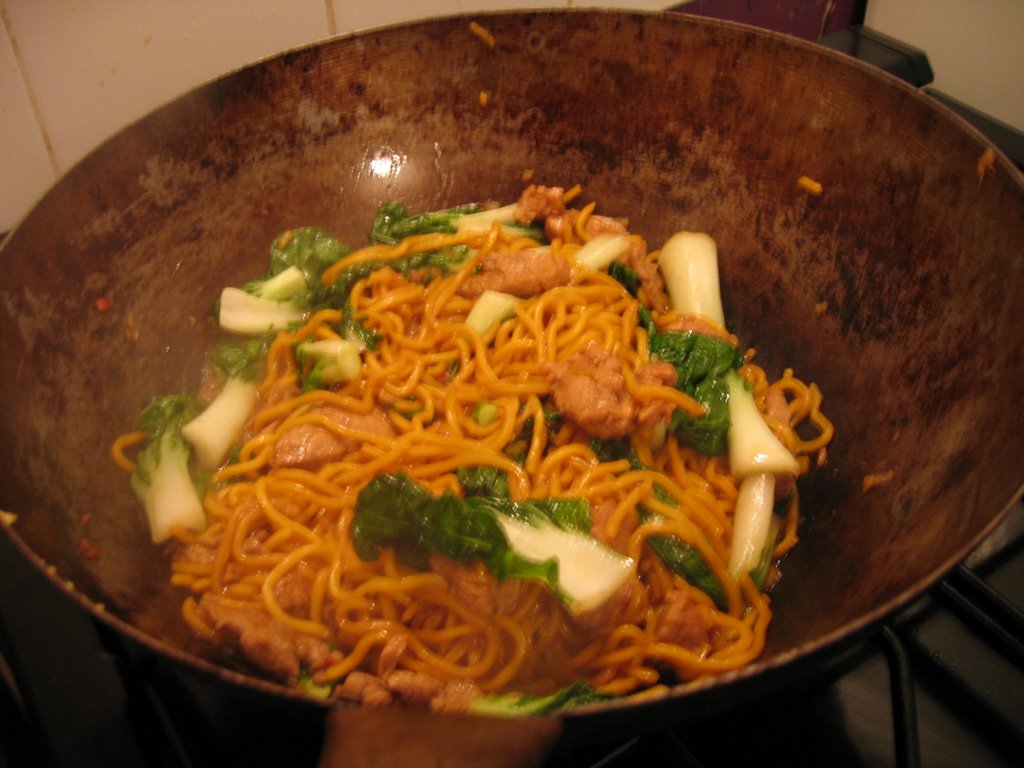
Soak the sliced pork in the rice wine while you chop the rest of the ingredients. Rinse the noodles in a colander to separate them. Separate the leaves of the bok choy and rinse. It is best to prepare everything before you start cooking. Heat the oil in a wok over a high heat till very hot, briefly stir fry the chilli, ginger and garlic then add the pork and stir fry till the meat changes colour. Add the noodles, soy and fish sauce, stir to coat everything, then add the water. When it simmers, reduce the heat, cover and cook for 4-5 minutes.

Uncover the noodles, return the heat to high and add the pak choi and the oyster sauce. Stir fry till the leaves wilt then toss through the spring onions and coriander and serve immediately.


Fabulous supper with less than 10 minutes cooking.