Monday, October 07, 2013

Hungary Pig


This little piggy weighs in at about 160 kilos and was raised on a small farm in north eastern Hungary to provide food, particularly lard, for the winter
A couple of months ago there was an email from Opentrips about an adventure to Hungary, specifically to a place called Mád. One pleasure of subscribing to this site is the momentary fantasy of going - trying new places, food, drink - cooking and eating in the company of  a bunch of others who also define this as pleasure.  

Full of things I didn't know - local wines to try - Aszu and  Furmint, fishing for perch pike and carp, cooking Hungarian food using local ingredients. At its centre was the killing and processing of a pig. I eat meat, am careful about where it comes from but I'd never been there at the death of  anything larger than a few fish and a lot of yabbies in the year we lived in Bourke. I wanted to know how the pig changes from animal to meat


The day started early - we all met up before 7am for a shot of Palinka - the local brandy, the traditional way to start.

There were about 15 of us all together, a ragtag assortment of people - curious foodies, bloggers, wine merchants, a journalist commissioned to write about the day, and a raw food chef who wanted to know if he would still eat meat occasionally  after seeing a pig killed for consumption.


The day was a bit drizzly, the only rain we saw all week.


The pig was to be slaughtered outside and then the carcass is broken down inside where everything is laid out ready.


Opentrips organiser Florian kept the whole trip running smoothly all week,


it all seemed deceptively simple with the invaluable skills and local knowledge of Gergely.


Once we were set to go, the pig, which was never frightened at any point, was taken from the cage with a squeal of incredible outrage. That sound will stay with me forever.

Rapidly stunned then the pig's throat was cut while half a dozen strong men held it down, the whole thing took less than a minute.


The fresh blood is collected into bowls and started to coagulate almost immediately. It was soon cooked up into a blood stew for breakfast - nothing goes to waste.


Once the pig has been bled out, it is moved from the concrete onto grass - the half dozen strong men were back in action.


High flame is used to burn off all the hair, a surprising amount.


Then the blackened carcass is scraped and scrubbed clean with a stiff brush in a bucket of water.


This is the end of the pig being a complete animal.

The head is cut off to be used in a couple of dishes later in the morning


The work of breaking the carcass down begins once the intestines have been carefully removed


to be cooked up to make fresh offal sausage later


The caul fat is also kept for cooking, just like everything else.


The big red pan is water boiling with garlic to which the chef adds the lumps of coagulated blood, then stirs gently to make sure it doesn't all break up. Once the blood is cooked with some onions and the brains too, a generous dollop of  lard is added to finish.


Breakfast is served - it was incredibly good to eat and very rich. One of the world's most amazing breakfasts


The butcher and his assistant brought the carcass inside to break it down with impressive skill into the various cuts of meat.


Outside over a sort of kettle drum fire chef had lots of pans bubbling away, including one with all the bits from the head


Drained,


it was chopped and mixed with lots of paprika it was stuffed into the pig's stomach


Then sewn up with needle and thread to safely encase all the meat.


It was boiled again for an hour or more and then, once cooled, it was pressed to make a sort of Hungarian brawn


The butchery was noticably different to the way pigs are broken down in England. All the meat is very lean - all fat is stripped off, including from the hams. Its kept to get the family through the winter - there is no other source of oil or fat available for cooking, so the primary purpose of raising pigs is for their fabulous lard.


There was plenty of it, though normally this pig would have been fattened further and then killed later in the year once winter was underway,


All the meat we didn't eat on the day was given to the local old people's home for the winter.


The hams were put to soak in water, salt and masses of garlic. They will be turned daily for three or four weeks till they are cured. Then - the vagaries of  Customs allowing - they will be shipped to Peckham to be served in some style at Peckham Bazaar.


Some of the fat was diced into sort of uber fatty lardon and then heated in a huge pan to be stirred with an enormous stick for a couple of hours.

The locals assured us this was the best thing about the day (the doctors call it cardiac soup) and it was amazing to catch a waft of that lovely pig fat melting and melting


till it reached a point of sort of hot confit - with about two thirds of the fat rendered and the rest hot fat salty crispy delights to go with beer.


The intestines were drained after boiling for a couple of hours, then minced

and added to rice and herbs and spices and turned  into liver sausage


that were then poached before being barbecued for dinne

All the bits and bobs of flesh - and there was a remarkable amount - were mushed together with shed loads of garlic and lots of paprika and dried herbs before mincing


and becoming big fat vibrant spicy sausage, also barbecued for our dinner.


Lunch was a surprisingly delicate soup made with some meat, bones and vegetables made amazing with a sprinkle of chopped pepper at the end


Then there was stew - all the gelatinous bits were boiled up together with quinces and peppers and things then finished with cabbage - both choucroute and finely shredded fresh - to make a gloriously hearty bowl of lunch accompanied by generous quantities of both dry and sweet furmint.

We all drifted off at that point for an hour before coming back for the final meal.

Had to be barbecue!!

We had lots of local pickles that were a great accompaniment to most of our meals, and the ones we had on the last night were made by a few from the group using veg we'd picked on the first day.


Perfect foil to the jerk spice ribs and the fab paprika sausages.

All that lard had one final use - hot lardy cakes fresh from the wood oven and served with raspberry coulis that had been cooked up earlier in the day. Lovely hot crunchy mouthfuls.


And this is what it is all about - look at this lovely pile of pig fat - it will keep the food rich and nourishing all through the cold winter.

Overall it was a most extraordinary day, I learnt a lot, ate some amazing food and will appreciate the meat I eat all the more.


Monday, September 02, 2013

Chocolate Orange Cake


Oranges may not be the only fruit but 300 years ago fresh oranges were expensive luxuries in northern Europe (and probably "fresh" wasn't always the exact word for them). I can see why - an exotic fruit of such a wonderfully vibrant colour, they promise much and once peeled the sweet segmented flesh offers no disappointment. The wealthy built orangeries in the grounds of their stately homes, not something I'd come across until I came to England, but the building of an orangery illustrates how besotted the wealthy were with this lovely citrus. A fine example is the baroque Orangery in the gardens of Kensington Palace which was built in 1704 for Queen Anne, who used it for parties. The architect was Nicholas Hawksmoor and was built with under-floor heating - remember this is the dawn of the 1700's - and in winter was used as a conservatory for delicate plants.

In those days if you could get oranges, they were marvellous for impressing your guests. They were a fleeting crop and one of the main concerns was how to preserve them, to savor their rich flavor and majestic colour all year. I'm guessing that that is why some clever cook came up with the idea of cooking them. The really distinctive flavor of an orange is in the peel, and so I offer this up as the motivation for the very first boiling of whole oranges.

This Nigella Lawson cake requires the boiling of whole oranges, 2 of them for 2 hours, and the who did it why first question has caught at the edges of my mind for the few months that I have been making it. Not who so much, but definitely why. They bob away - you can't drown an orange - and gradually become squidgy - soft and wet and changing shape easily when pressed. They lose their smooth exterior and all that reassuring firm resistance they have when just picked and basically end up the very opposite of what you want in a fresh orange. The first time I made this recipe I reached the 'boil oranges for 2 hours then cool slightly' point and really, seriously, did not believe we were going anywhere good.

How wrong I was.

Chocolate Orange Cake
The baroque Orangery, located next to Kensington Palace in Kensington Gardens, was built in 1704-05 for Mary's younger sister, Anne, who became Queen when William died. Anne used Kensington for entertaining and she held parties in the Orangery.
The building had under-floor heating and in winter it was used as a conservatory for delicate plants.
The architect of The Orangery is thought to have been Nicholas Hawksmoor, the clerk of works on Kensington Palace and the designer of six new churches in east London.
- See more at: http://www.royalparks.org.uk/parks/kensington-gardens/facilities-in-kensington-gardens/the-orangery#sthash.7UYP8MLn.dpuf
The baroque Orangery, located next to Kensington Palace in Kensington Gardens, was built in 1704-05 for Mary's younger sister, Anne, who became Queen when William died. Anne used Kensington for entertaining and she held parties in the Orangery.
The building had under-floor heating and in winter it was used as a conservatory for delicate plants.
The architect of The Orangery is thought to have been Nicholas Hawksmoor, the clerk of works on Kensington Palace and the designer of six new churches in east London.
- See more at: http://www.royalparks.org.uk/parks/kensington-gardens/facilities-in-kensington-gardens/the-orangery#sthash.7UYP8MLn.dpuf
The baroque Orangery, located next to Kensington Palace in Kensington Gardens, was built in 1704-05 for Mary's younger sister, Anne, who became Queen when William died. Anne used Kensington for entertaining and she held parties in the Orangery.
The building had under-floor heating and in winter it was used as a conservatory for delicate plants.
The architect of The Orangery is thought to have been Nicholas Hawksmoor, the clerk of works on Kensington Palace and the designer of six new churches in east London.
- See more at: http://www.royalparks.org.uk/parks/kensington-gardens/facilities-in-kensington-gardens/the-orangery#sthash.7UYP8MLn.dpufIf you could get oranges, they were great for impressing your guests. But one of the main things on your mind would be how to preserve them, to savor their rich flavor and majestic color all year.

I am far from a cake fanatic but I have made this one at least half a dozen times over the last few months, and everyone that eats it wants the recipe. I understand. It is a great cake, rich and elegant and properly grown up and sophisticated.


2 oranges, unwaxed ideally
200g ground almonds
50g cocoa
6 eggs
1 teaspoon baking powder
1/2 teaspoon bicarb soda
250g caster sugar

Put the oranges into a pan of water and simmer for 2 hours, until they go unattractively soft. Set aside to cool.

Heat the oven to 180C and grease and line the base of a 20cm spring form tin.

Cut the oranges in half then put them into a blender – skin pips and all – and whizz to a paste like consistency. Add all the rest of the ingredients and blitz again till you get a lumpy batter. If your blender is not big enough to put everything in, tip the orange pulp into a bowl then blitz the rest of the ingredients in the blender, add that to the orange and mix till it's all combined.

Pour the mixture into the tin and bake for about an hour till a skewer comes out clean. 

Leave the cake in the tin on a wire rack for 20 minutes or so to start cooling then carefully unclip the outer ring and take it off. The cake can cool fully on the metal base before serving.


Wednesday, August 21, 2013

Five Things I Ate This Week

Loving this summer we're having, it's good as a bought one. So I thought I'd share five things I made this week that fit the summer theme and were utterly gorgeous to eat.


 There was spinach pie - I had some small bits of cheeses to use up, along with a few spring onions, lots of eggs and half a bunch of fresh dill. All I needed was spinach and filo. Pleased to say that I discovered that reheating in a small pan with a little olive oil re-crsiped the pastry next day for lunch. 100% yum.


 Went to see Liola at the National - a delightful production - so I made salami sandwiches topped with cucumber, peashoots and greens from my garden. Doesn't get fresher than that! Enjoyed them as a picnic on the theatre terrace overlooking the Thames with a glass of wine and a packet of crisps. All made for an enjoyable evening.


 This is the very definition of garlic chicken! I boiled potatoes with garlic and olive oil, then mashed them as the base for chicken I fried with garlic, bay leaves and sherry and served a side dish of roasted Amalfi lemons, banana shallots and garlic. Inspiration came from Jose Pizzaro's book - and it was a great mid week supper


 Continuing the Spanish theme this is a white gazpacho, made with cucumber, avocado and yoghurt with an intense underlying flavour from ginger, coriander and sherry vinegar. I loved it, the man was not convinced.


He was however utterly delighted with home meade pizza - and so he should be! I made this beauty - my first ever successful pizza - with dough topped with buffalo mozzarella, spicy salami and marinated mushrooms in a very hot oven, then topped with a sprinkle of greek basil. We ate it double quick, then ate another. Friday night at its best.


Monday, August 12, 2013

Crocodile Steaks


Never smile at a crocodile
No you can't get friendly with a crocodile
Don't be taken in by his friendly grin
He's imagining how well you'd fit within his skin

My mother used to sing that to me when I was a kid. She spent her working life teaching five and six year olds and her spare time coaching them to be brilliant in Eisteddfod, with the result being that her face took on such a wonderful animation when she sang these kind of songs, and hearing her sing this one in particular made all within earshot squeal with terrified delight.

Crocodiles are ancient creatures, possibly around even at the time of the extinction of the dinosaurs, and as they move so smoothly between water and land you can almost see evolution in progress. I've seen them in the wild as well as in zoos around the world and mostly they are very still, so you'd hardly notice them at all. I was intrigued by them at Berlin Zoo on a long ago visit and stood watching a group of them for 20 minutes or more. I swear none of them moved a muscle apart from an occasional blink. Then it was feeding time and a keeper stood on a bridge above them and threw down hunks of meat - there was an immediate frenzy of thrashing limbs and snapping jaws. I was on the other side of a glass wall and I was TERRIFIED. Others may claim to imagine handbags and shoes when they see them but me? Nooooooo. I'm way too busy making sure I'm not smiling.


Recently I went to a food and wine pairing with wines from Touraine in the Loire, with the talented winematcher Fiona Beckett hosting the evening. Matching half a dozen dishes  with two wines each it was interesting to compare not just the wines but also the way they changed with the food. With sole goujons and chips - apparently sauvignon blanc has been voted a great wine pair with one of Britain's favourite dishes - I liked the grassy freshness of  the Domaine Guenault, Famille Bougrier 2011 on first sip but was surprised at how much it brought out the flavour of the food. I was too quick with my quaffing to follow Fiona's suggestion of trying it first just with the fish then adding lemon juice and trying again but with the lemon there was a proper balance of the wine's acidity with the citrus. Might have to move on from my go to pairing of beer and chips!


Over the course of the evening the assembled group of invited bloggers tried a variety of reds and whites with different foods. I am always a bit uncertain about how to make the matches but Fiona was both incredibly knowledgeable and quite reassuring. She makes the point that as you cook you taste, and the choice of wine is simply part of that tasting process rather than, as I tend to think, a separate activity. Wine can obviously improve the experience of food, and she explained that the way food is cooked is usually more relevant than the base ingredients, so the strong flavours of the smoked venison with a red wine reduction we had towards the end of the tasting really needs the robustness and slight funkyness of the Henry Marionnet, Vinifera 2010, a great balance of  flavours of food to wine, and my favourite wine of the evening.


The last wine of the night was lightly chilled Domaine Paget Sparkling Rosé, a wonderfully unsweet slightly berryish richly pink glass of fizz. After the evenings tuition we were invited to make our own matches with a brilliant array of berries and fruits, brimmimng bowls of chantilly and mascarpone, piles of pretty biscuits and an assortment of chocolate in various forms. I laid out an attractive selection plate and set to with gusto. Though I'm not really a fan of white chocolate it was okay with the wine, the raspberries were a better match, I liked the sharp tang of the lime segments though you wouldn't do a lot of them!

It is part of developing what Fiona describes as a palate memory - honed by trying wine and food in different combinations and different situations and remembering what you like. The last element to successful matching is just being appropriate - a cheap simple wine is a quaffable match to a plate of pasta, a wildly expensive rare vintage is the obvious starting point for an entirely different menu, the wine determining the food in this instance.


In the end my dessert of choice for the rosé was probably the simplest food on my plate - juicy slices of nectarine with a light grind of black pepper - the rich sweetness of the fruit and the tiny prickles of heat was a great match for this rosé, sumptuous enough to match the bubbles and wonderfully clean after taste - refreshing on a surprsingly hot summer evening.

At home on the weekend my cousin and her husband were visiting from Australia and they came to visit with their son and his wife, the lovely J&M - a perfect excuse to chill the pink bubbly. I paired it with mostly savoury things and I loved the way it matched the richness of the guinciale in particular.


There was also a bottle of Morrison's Touraine Sauvignon Blanc, 2011, that was paired on the tasting night with a prawn and noodle salad and it worked well with the chilli and seafood. Once home I went round and round wondering what to match it with, settling briefly on something lemony and chickeny then deciding  there must be something better. Watching Celebrity Masterchef the other night the contestants were given crocodile as one of  the mystery ingredients, to some consternation it has to be said. The man grinned with delight and said how come we never have crocodile? For me it was the eureka moment.


I'm not sure if crocodile is technically seafood or land creature - fish or fowl? - but it is definitely a white flesh that is more robust than delicate and extremely lean with it. I bought a couple of tail fillets - pieces you understand, not whole tails - from the Exotic Meat Company at Borough (they do mail order) and marinated them for a few hours before flash frying them. I made a bowl of fresh cabbage salad and added a tablespoon of  toasted desiccated coconut and served it all with plain basmati.


Marinated Crocodile Steaks

Serves 2

2 crocodile steaks from the tail - though thinking about it if it's not the teeth then crocodile is mostly tail
Juice of 1/2 lime
1 tablespoon olive oil
1 small green chilli, thinly sliced, deseeded if you don't like it too hot
1 tablespoon grated ginger
1 garlic clove, peeled and crushed
1/2 teaspoon salt
1 tablespoon unflavoured vegetable oil

Put the crocodile steaks into a flat bowl, mix the juice, olive oil, chilli, ginger, garlic and salt until well combined and pour over the meat. Rub well into both sides of the flesh then cover and refrigerate for a couple of hours.

Warm the vegetable oil in a fryng pan over a high heat. Add the steaks and cook for 3-4 minutes on each side till lightly crusted and cooked through. Serve with rice and cabbage salad and a chilled glass of sauvignon blanc.


I'm delighted to say the wine worked a treat with it all, really bringing out the flavour of the meat and making for a great end to a really enjoyable weekend.

Have to include this photo of the handsomest dog in the world - Eddie came along for the excitement - and was definitely intrigued by the rosé!


Wednesday, July 03, 2013

Lunch at Noma


On Friday last week the man and I had lunch at Noma with the lovely J& M - even typing 'had lunch at Noma' sounds unlikely. But so very true... It's an ambition we've chatted about for a very long time - I did think for a while it would simply be a tantalising dream forever unrealised. But things happen and sometimes dreams come true.

Fast forward to a sunny day in Copenhagen, perfect for a stroll down to the water where Noma is housed in an old warehouse. We stepped down into a beautifully understated room and a whole crowd of staff smiling and greeting us, including the extraordinary chef Rene Redzepi. Was astounded to find him there for service. It was the beginning of the thrill that lasted for the next four hours of intensely flavoured food, all of it beautifully plated and explained with great detail by a profusion of charming and well informed staff. I felt incredibly welcome to be there, that everyone was as delighted as us at the prospect of lunch.

There were about 20 courses in all.

We started with champagne - why not? - to accompany a quick succession of glorious little dishes to share. First was Nordic coconut, big fat green kohlrabi that had been hollowed out then filled with a juice mix of crushed unripe strawberries and sea buckthorn, brightly cleansing and vaguely orangey all sucked up through a straw made from one of the stems. This was fun.

There was a vase in the centre of the table with a display of small branches and flowers - pretty but it did seem slightly out of place. There are no tablecloths in sight, soft light spills in all around through the enormous windows, the room is a palely beautiful thing of various soft greys and the staff, too, wear muted shades of grey. A couple of small dishes of home made creme fraiche were set before us - to be used to dip the centre branches of our floral display. Seriously, the branches. They were malt bread fern frond cut outs coated in a fine juniper dust, tasting almost bitter and very dry when I curiously nibbled the end. Hmmm, Nordic I thought, then I dipped it into the creme fraiche and it was silky and intense - ah, wonderful, I thought.

Next was one of my favourite things - moss and cep. Reindeer moss explained the waiter, with a shaving of dried cep. The moss was how I imagine a cloud would be if briefly deep fried - tiny delicate strands of crisp, sort of there and not there, the cep adding a very slight dusting of earthy - a really lovely dish.

After moss there was a triumph of culinary skill - verdantly green pea pods where the inside had been peeled and removed and the remaining fine skin stuffed with peas, pine and chamomile. One each and they were pea perfection. (We had a tour of the kitchens after lunch and saw the  young stager intently peeling a large bowl of pea pods for the evening service, least favourite job in the kitchen by all accounts though he, like everyone else, was remarkably cheerful in his diligence.)

Peas eaten, we were presented with a battered old biscuit tin, the lid off to reveal little tin flan cases - mostly empty I'm sad to report - but the four that weren't had a perfect disc of deeply savoury cheese biscuit topped with the stems of rocket chopped fine to the size of match heads - a glorious mouthful of both flavour and texture. Then there was berry and roses that tasted like the best wine gums the world will ever know followed by a large speckled egg that opened with a whisp of smoke to reveal tiny pickled and smoked warm quail's eggs nestling in a pile of straw.

Next was one of my favourite things - though the degrees of separataion between loving it and favourite are miniscule - this is one that really amazed me. It was a sheet of caramelised milk - ie milk (skin?) that has been reduced down till it is no longer liquid and has formed a thin golden sheet - topped with small, noticeably cold, discs of cod liver the size of a one penny piece that melted into a decadent richness on my tongue. Heaven.

It was followed by a dish that made us laugh out loud as it was set down. Imagine warm fat beignets the size of golfballs, stuffed with cucumber jelly and stuck through with smoked baby herring, head poking out one side, tail the other. It was our very own plate of stargazy donuts! I'm not generally a fan of little fish still with their heads and tails but these were very yum indeed.

Following the couple of fish dishes was a lovely clean tasting sorrel and nasturtium plate, the sorrel leaves stood like sails at the edge of the bowl, to be used to scoop up a sort of grainy nasturtium sea. And then big fat crayfish warm and split, with juicy claws and a small bowl of something indescribably wonderful to dip into. I still don't know what it was.

The final starter - yes, we are still on the introduction to the meal - was a big fat burnt leek set before us with a waft of barbecue. Our Australian waiter - who was in fact one of the sous chefs as some of the dishes are served by the kitchen staff to add extra depth to explanations making the meal ever more seamless - laughingly suggested the chef could use a few more lessons on cooking over coals. It was the interior we ate - the leeks had been hollowed out then filled with short lengths of baby leek with a creamy cod roe - all of it smokily steamed to melting perfection inside the big leek.

You will no doubt have noticed by now that I wasn't taking lots of photos despite the incredible wit and beauty of every dish. For me it interrupts the pleasure of eating, metaphorically taking me away from the table and I seriously wanted to be immersed in this lunch entirely. Apologies if you miss them. I did, however, take a few...


This was the first of the main courses. Up to this point all the plates had come in really quick succession and were placed in the middle of the table for sharing. This exquisite looking plate was all mine! I will admit I half expected a fat green frog to emerge from under one of these pretty lily pads but no - what we had was raw Skagen shrimp and ramsons, with rhubarb root and flowers and it tasted as delicately beautiful as that bowl looks.

The next plate was thin slices of scallop that had been dried to almost crisp served on grains - barley I think with the peppery bite of watercress and a slight oily crunch of hazelnuts all of it in a coal black slick of squid ink. It stained under my fingernails as I tried to mop up every last drop.

Next up was a deceptively simple looking dish, a medley of soft browns amid translucence - shards of roasted onions and slices of fermented pears - with a scattering of black flecks. The flecks were black ant sauce, said our waiter. We glanced at each other briefly, quick shrug, then tucked right in. Allow me to recommend ant sauce next time you are serving onions with fermented pear.

Possibly the most Nordic looking dish so far followed. Asparagus - a thing I love - here was served with the white stalks roasted, the green pureed and served with cream and pine twice - once for eating, which were the fine pale green new shoots about a centimetre long alongside little branches, there just for decoration.

Next was potato and bleak fish roe. The potato had been rolled in a kind of mould or fungus then roasted - they looked like the chestnuts that get sold round the streets in winter. They were very earthy - I'll admit I was not entirely sure. The bleak fish can find solace at least in the fabulousness of the tiny quenelles of roe that were served alongside, yet another version of wonderful.


Hidden within this beautiful symphony of white and deep green above is a little package of pike perch wrapped in cabbage, grilled to make for richness and delicacy together.  The leaves poking out are verbena and there is a little dill in there too - the whole dish was light as the foam on top, all of it gone in moments.

The empty plates were taken away and replaced with this beef rib. One each.


It was the very last of the savoury dishes and was so beautiful to look at. The ribs are cooked for a week, hence the expanse of clean bone, then topped with lingon berries, tiny tart juicy little fruits that I first ate with J& M one Christmas, my first taste of Sweden. I loved this dish, the incredibly tender meat was richly flavoured and the sharp crisp topping - which looks to me like Christmas on the bone - was perfect with it. We ate it with our hands, no cutlery provided, somehow increasing the pleasure.

Dessert first was gammel dansk, a bitter herbal liqueur made into sort of crisp shards served with a little pile of herbs and toasted bits, very sharp and clean. And lastly, rhubarb and milk with brown cheese and oxalis. (My mother weeds oxalis from her garden in a frenzy every time it pops up) Despite the way it reads this came out looking like a Danish pastry, crowned with a slick of 'chocolate' disc and lovely with it.

And then it was - not quite - over. We were taken through to the bar on the other side for coffee and amazing chocolate crunchy things, utterly blissed out with the pleasure of such an extraordinary meal, chattering happily for the next half hour or so.


This charming woman was one of the many that served us - she was such delightful fun all day


Having written all about it I am left with the sense that I have an insufficiency of language to describe just how much I enjoyed our meal at Noma, the sheer giddy enchantment of it. What can I say?

Go if you can.

Monday, June 24, 2013

Chicken & Peppers


A dish of beauty
Faster faster faster! When did speed become the defining criteria for dinner happening or not?. Simple I get, tasty I need, beautiful I can be seduced by - but fast? Not so much. Fast food as a term was recoginised by Websters Dictionary in the early 1950's but I'm guessing that what  would be recognised then as fast food would never be sold in the mutli national giants today.

Thought I might reclaim the term just a smidgen, and categorise food that takes less than 15 minutes to prep as fast food. Fifteen minutes is no time, I waited longer than that for a bus yesterday and still got home in time for tea.

So here, without further ado, is possibly the simplest dish this blog has ever posted. It is exactly what it says in the title, just chicken and peppers. What gets served up an hour later with rice is a vibrantly beautiful plate of food that tastes rich and complex. Magic.

Chicken & Peppers

The peppers cook down and mix with the juice released by the chicken to make a lovely sauce that needs some rice or perhaps just lots of crusty bread to soak it all up

For 2

4-5  chicken thighs and/or drumsticks, on the bone, skin on
6-8 bell peppers, a mix of red and yellow (but not green as you are looking for sweet), chopped into large dice
2 tablespoons olive oil

In a large lidded saute pan warm the olive oil and cook the chicken pieces skin side down for a couple of minutes till the skin is crisply golden. Take the chicken out of the pan onto a plate and leave to one side for a couple of minutes while you fry the peppers, stirring occasionally until they start to soften. Return the chicken to the pan, skin side up, and season generously. Once the peppers start to give up their juice, turn the heat right down, cover the pan and leave to cook for 45 - 50 minutes.

Serve over plain boiled rice.

Seriously, that is all  you do.


Tuesday, June 18, 2013

Tidbits


THE BOYS ARE ON THE WAGON
THE GIRLS ARE ON THE SHELF
THEIR COMMON PROBLEM IS
...THAT THEY'RE NOT SOMEONE ELSE
THE DIRT BLOWS OUT
THE DUST BLOWS IN
YOU CAN'T KEEP IT NEAT
IT'S A FULLY FURNISHED DUSTBIN
...SIXTEEN BEASLEY STREET


Festival Hall has the cleaners in - great view from Baylis Terrace


The Shed at The National

Was an interesting week last week, only just catching up. Started Friday night with tickets for The Shed to see Mission Drift, a fabulous musical about money and America - great performances, brilliant music. The Shed itself is a big red box with 'legs' sticking up, for all the world like a giants' table knocked over in a gust of wind. I'd been curious about it but also decidedly uncertain as it appears to be a small windowless box whenever I catch sight of it from Waterloo Bridge on my way home on the 59 bus. Not a fan of enclosed spaces, me. Then I read an interesting piece about the architecture that piqued my curiosity and soon after an email offered cut price tickets - had to be a sign. I was completely bowled over by it once I got inside, it has the extraordinary sense of being ten times as big inside as it appears to be on the outside, and wonderful with it.

In the Shed


The show started at 7 so we joined a few others at the tables dotted about on the Baylis Terrace for homemade ham sandwiches and a glass of wine from the bar. It was cold but not freezing - there was actual late afternoon sunshine - and is probably the most summer like thing we've done this year...


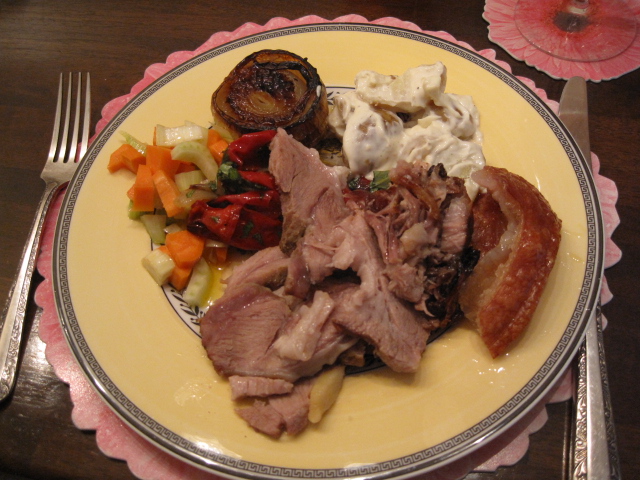
 Late Sunday afternoon treat of slow roast pork with salads - I persist in the notion that it's summer! Great meal before going out and plenty for lunches in the week.


Sunday night we had tickets for the Palladium, a thrill in itself, to see a comedy evening headlined by John Cooper Clarke, a wordsmith I have loved for decades. I first saw him in Sydney about 30 years ago, playing the Trade Union Club in Surrey Hills, he was just stood on the floor with the crowd around him, spouting the most extraordinary poetry at a million words a second. He was beyond stick thin - I swear my wrists were thicker than his thighs, dressed in a black suit with a white shirt, and an enormous head of spiked black hair. Impenetrably dark ray bans completed the look. I was completely blown away by his brilliance, his use of language was like nothing I had ever heard, a great spume of nasty and bitter and funny in a totally foreign accent. I left the club that night giddy with the thrill of it.


I've seen him a few times since, often as I get the chance, initially convinced he'd be dead in no time from the out of control drug habit.


But somehow that didn't come to pass, instead he cleaned up, having starred in an ad for Sugar Puffs with the honey monster a few years before that happened - a notion that is as bizarre as it sounds.

Been there...

He's gained all kinds of recognition over time, as students who loved his every word went on to be teachers, with enough influence to get his poetry into schools, even Twat made it on to the curriculum for GCSE. Mr Gove, it's for you.